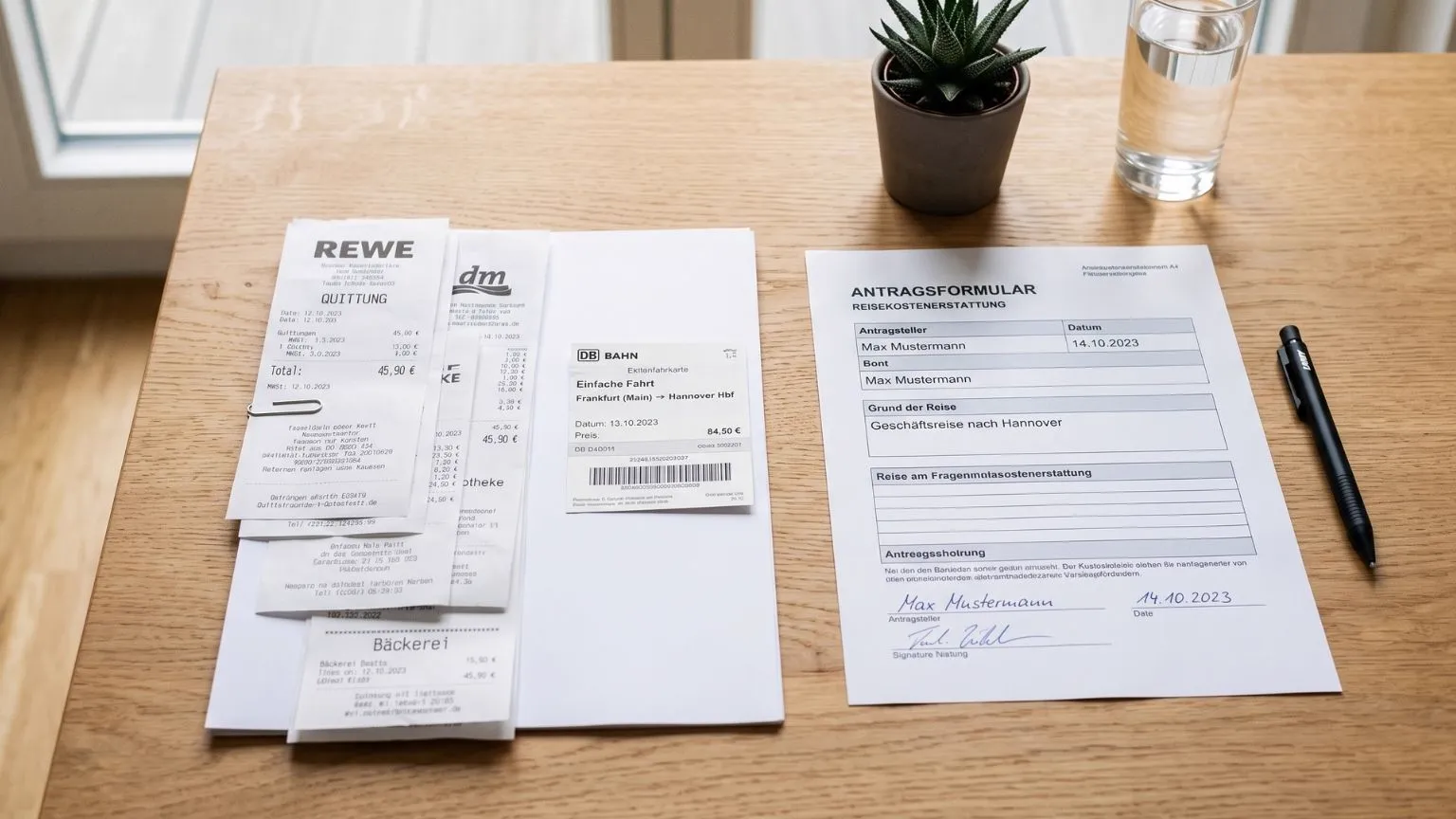
Applying costs money. Photos, folders, postage, certified copies, the train to an interview at the other end of the state. If you are registered as unemployed in Germany, you do not necessarily have to carry that yourself, and the most common mistake is not a formal one but a matter of timing: the application for funding arrives too late.
This article explains which costs qualify, how to apply, and what to do when the answer is no. For documenting the applications themselves, see the guide to proving your job search.
Legal status: August 2026. Orientation, not legal advice.
What the agency can cover
The legal basis is called Vermittlungsbudget, the placement budget, and it sits in section 44 SGB III. The paragraph is deliberately open: what can be funded is whatever initiates or supports taking up employment subject to social insurance.
The word that matters is can. This is a discretionary benefit. You have no automatic right to a particular amount, but you do have a right to the agency exercising its discretion properly. In practice that means it is worth asking, and worth giving reasons.
Typically eligible:
- Application documents: photos, printing, folders, postage, certified copies
- Travel to interviews
- Accommodation for long journeys
- Costs of starting work, such as a second household or a relocation grant
On Buergergeld the same applies through section 16 SGB II, with the Jobcenter responsible.
Flat rates and online applications
There is no statutory flat rate per application. What exists are internal reference values, and they differ between agencies. Which is why no figure appears here: any number you read elsewhere may simply be wrong for your office. Ask at your appointment which value applies and have it noted.
With online applications the argument often goes that no costs arise. That is only half true. Application photos cost money, certified copies cost money, and plenty of processes still ask for documents by post at the end. Apply for what actually arises and evidence it.
One point that gets missed: a coaching voucher is also a benefit from the same funding system, only under a different paragraph. If your real problem is not postage but the applications themselves, that is the more interesting route.
Travel to interviews
Here a detour pays off before you go to the agency. Whoever invites you to an interview generally has to reimburse the necessary costs, unless they excluded that expressly; the principle is derived from reimbursement of expenses under section 670 BGB. Many German employers therefore state in the invitation whether they cover travel. If it says nothing, asking is entirely legitimate and holds nothing against you.
Only when the employer does not pay does the agency come into play. Then the same rule applies as everywhere: settle it beforehand. Usual practice is reimbursement at the cheapest rail fare, or a per-kilometre rate for a car. Your caseworker will tell you what applies before you travel.
Keep: the invitation, tickets or fuel receipts, and confirmation from the employer that the appointment took place. Without proof of the appointment it gets difficult.
Apply beforehand
This is the core of the article and the most common mistake at once. Funding is applied for in respect of costs that have not yet arisen. Print the folders, buy the ticket and then turn up with receipts, and you will as a rule receive nothing.
The reason is not obstruction but structure: what gets funded is a step the agency could decide on in advance. Retrospectively there is nothing left to decide.
In practice:
- Raise it early, ideally in the meeting about your integration agreement. What is written there is easier to claim later.
- Apply before you buy or book anything. Informal writing usually suffices; many agencies have their own form.
- Wait for approval and keep the decision letter.
- Submit the evidence as the letter describes.
If an interview comes up too fast for that route, call before you travel and note the answer with the date and the name of the person who gave it.
Step by step with evidence
What you keep together decides the rest.
- The invitation or the advertisement the application came from
- Receipts for the costs: till receipts, tickets, invoices
- Your application log for the period, because it shows the costs belong to real applications. What it looks like is in the article on the application log.
- The approval letter, if you already have one
Submit everything together rather than in instalments. An incomplete application slows down, and delay is the real risk when deadlines are involved.
When the agency says no
A refusal is a formal decision, and a decision carries a Rechtsbehelfsbelehrung with a deadline, normally one month. The objection itself needs little: writing, the file reference, one sentence. The reasoning may follow later.
An objection makes particular sense when the refusal is blanket. With a discretionary benefit it has to be visible that discretion was exercised at all. A letter saying only that there is no entitlement misses the point: you never had an entitlement to the amount, only to a properly reasoned decision.
And regardless of any objection: ask why. Sometimes a single piece of evidence is missing, and the matter is settled with an email rather than a procedure.
The tax route
Independently of the agency there is a second path, and it gets forgotten: application costs are Werbungskosten, work-related expenses, and they reduce your tax bill even when the application failed. Deductible items include photos, printing, postage, travel and professional literature.
Two caveats. First, whatever the agency reimbursed cannot also be deducted, otherwise it would count twice. Second, keep the receipts here as well, and an application log helps because it links each receipt to a specific application.
Whether it is worth the effort depends on having taxable income that year. In a year with no income the costs run into nothing, unless you worked during the same period or claim a loss carried forward. That is the point where advice beats a guide article.
Frequently asked questions
How much is paid per application?
There is no statutory flat rate. Agencies work with internal reference values per application, and they differ. Ask at your appointment which figure applies to you rather than trusting a number from the internet.
Are online applications reimbursed?
Costs arise there too: application photos, certified copies, postage when documents are requested later. Whether and to what extent that is covered is decided case by case, because this is a discretionary benefit.
Do I get mileage if I drive?
Possibly, usually at a per-kilometre rate. It is settled before the journey, not after. Also check whether the employer pays: whoever invites you generally has to reimburse the necessary costs unless they excluded that expressly.
Does this apply on Buergergeld?
Yes. Funding from the placement budget applies under section 16 SGB II as well. The Jobcenter is then responsible and the application goes there.