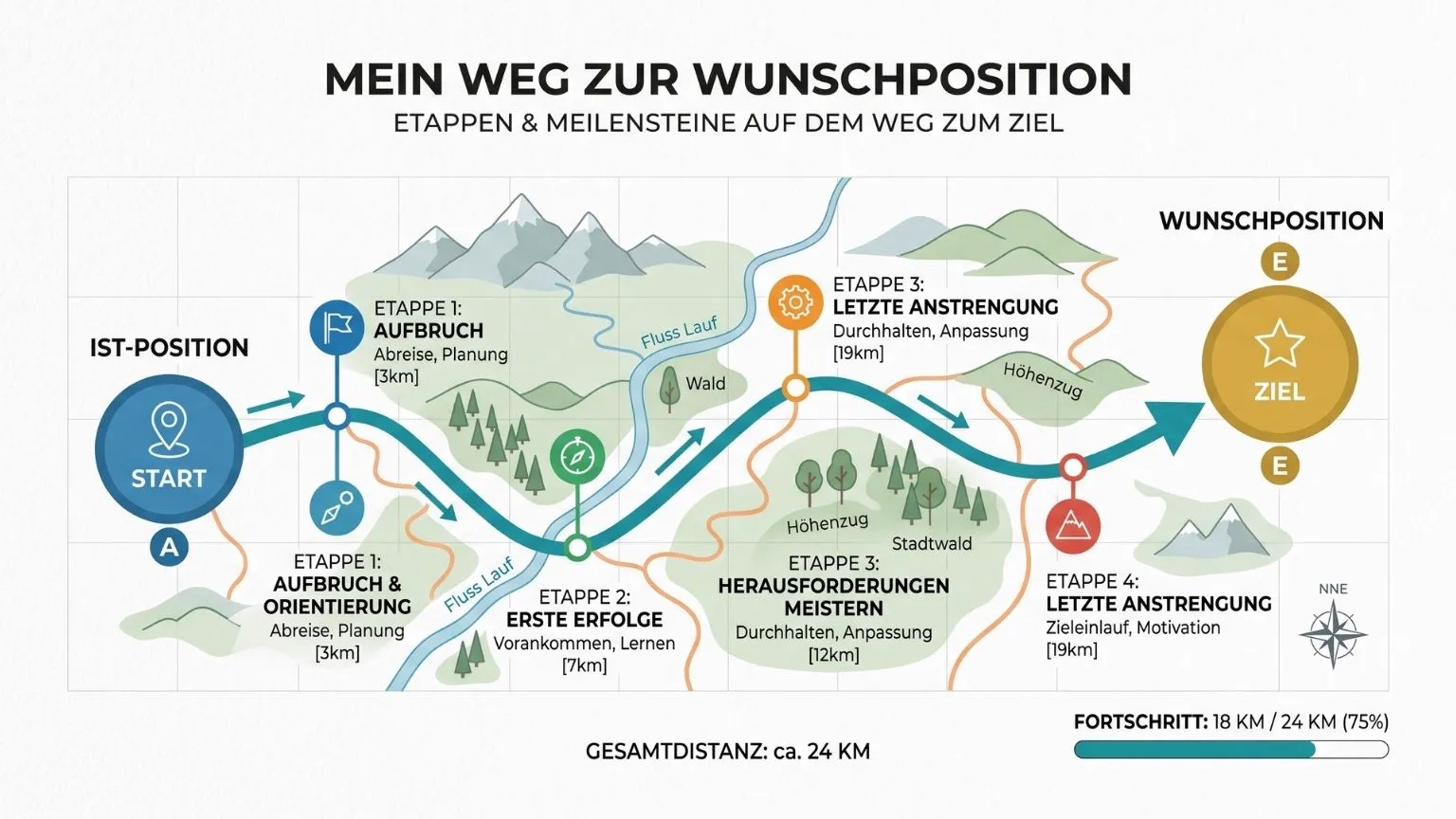
"Where do you see yourself in five years?" is the question that makes perfectly good candidates flounder. Not because they prepared badly, but because they are honest: they do not know exactly. What follows is almost always the same sentence, something about more responsibility. That is not a goal. It is an embarrassed placeholder in a suit.
This article turns the vague wish into something you can say out loud without squirming: the inventory that comes first, three levels instead of the usual buzzword formula, and how to use the result in a German cover letter and interview. Where all of this sits in the sequence of an application is in the complete application guide.
"More responsibility" is not a goal
Vague goals paralyse you, and not because they lack ambition. They paralyse because you cannot walk towards them. "More responsibility" cannot be written into a calendar. There is no Monday on which you start, and no Friday on which you can see you got closer.
There is a second effect you only notice in hindsight: without a goal you apply reactively. You take what catches your eye instead of looking for what fits. Three years later you have a CV made of perfectly sensible individual decisions that still has no through line. And that through line is exactly what interviewers ask about.
The opposite failure exists too: goals that are too narrow. "Head of sales for the northern region by September 2028" sounds like a plan but is a bet on one specific job you do not control. If it never opens up, you no longer have a goal, you have a disappointment.
Usable goals sit between those poles. They say where, without pretending to know the route in detail.
The inventory: what you can do, what you want, what the market pays
A goal without an inventory is a wish. Three questions, in this order, because each one makes the next answerable.
What can you do? Not what your CV says, but what you actually command, including the parts nobody issued a certificate for. The fastest route there is unglamorous: write down ten tasks from the last two years that came easily to you, and three that drained you every single time. That list tells you more about your direction than any personality test. If you need wording that also holds up in an application, collect it in the Strengths area, where it is stored in a form you can reuse later.
What do you want? This is about the content of the work, not the title. Do you want to build or to operate? To decide or to advise? To work with people or with systems? A title is a label on an activity, and labels differ more between two companies than the activity underneath. Build a goal on a title and you end up in a role that is named correctly and feels wrong.
What does the market pay? This question decides whether your goal describes a career or a hobby. The Entgeltatlas run by the Bundesagentur für Arbeit, Germany's federal employment agency, shows actual pay by occupation, region and requirement level, and BERUFENET tells you which qualifications and duties really sit behind a German job title. Both are free and beat any gut estimate.
Phrasing goals that hold
The usual goal formulas from the advice literature fail at one point: they demand measurability and deadlines for something you only half control. Whether you get promoted is not your decision. Whether you prepare for a promotion is.
Hence three levels instead of one formula. Each has a different degree of sharpness, and that is the whole trick.
Level 1: the direction, three to five years. One sentence about the kind of work, no job, no employer. Example: "I want to move away from pure case processing towards a role where I design workflows instead of executing them." This level is allowed to stay blurry. It is the compass, not the route.
Level 2: the position, twelve to twenty-four months. Now it gets concrete enough to search with. Example: "A role in process management, at a company from around 200 employees, within 50 kilometres, with budget responsibility from the second year." That is not a wish list, it is a search filter. You spot a matching advertisement in ten seconds.
Level 3: the next step, three months. Something that depends on you alone and carries a date. Example: "By the end of February, take over the project lead for replacing the order form and finish the process modelling course." This is the only level you can deliver entirely yourself, and therefore the only one you may miss without the rest collapsing.
A counterexample: "I would like to develop further and take on responsibility" contains none of the three levels. It says neither where, nor what you search for, nor what you do on Monday.
Using career goals in the application and the interview
In the Anschreiben, the German cover letter, the goal belongs in the closing part, in one sentence, and always tied to the role. "Building the internal process handbook is exactly the direction I want to grow in" works. "I am looking for a new challenge" does not, because it could have been written about any job in the country.
On the Lebenslauf it does not belong at all. The German tabular CV is a chronicle, not a short-form cover letter, and an objective section looks foreign in it. An English CV or resume works differently: a summary of three to four lines at the top is standard there, and the direction may sit inside it. If you apply in both languages, keep two versions and do not blend them.
That leaves the interview question. It is not aimed at your life plan but at two things: will you stay a while, and does what you want match what exists here. An answer that serves both looks like this:
In five years I want to own workflows rather than just operate them. For the next two years that means building out the process side of this role until I run projects independently. Whether that turns into a team lead depends on what grows here.
The last sentence matters most. It shows direction without dictating an org chart. If you apply inside your current employer that counts double, because the person across the table knows your current role and can judge the jump. How to handle that is in the article on the internal application.
The plan behind it: milestones and checkpoints
Most plans are missing the middle layer between goal and everyday work. A milestone is something that is either reached or not: the qualification, the first project lead, the offer. A checkpoint is a date on which you look at whether the direction still holds, with nothing required to be finished.
Four checkpoints a year are enough. At each one you ask three questions: what have I done since the last that pays into level 1? Which advertisement matches level 2? And what is the next three-month step?
Keeping those books in your head does not work. It needs a place. Career Goals holds the goal, the milestones and the dates, and shows which of your running applications pays into which goal. That is less effort than it sounds, and it quietly answers the interview question about what you worked on lately.
Changing your goals is allowed
A goal is not a promise to your earlier self. If the inventory produces something different eighteen months later, the old goal was not wrong, it did its job: it got you moving and showed you what you do not want. That is a result, not a failure.
Two triggers for a correction are reliable enough to plan for. The first is a new task that unexpectedly suits you. The second is a rejection with an honest reason, because it shows you a gap between level 1 and level 2 that you could not see yourself.
What you do not do is change the levels at the same time. Change the direction and leave the next three months standing. Usually the step you started pays into the new goal too, and if it does not, you finish it in twelve weeks and start again cleanly.
Frequently asked questions
How do I answer the question about my goals in an interview?
With a direction and a next step, not with a job title and a date. Say what kind of work you want to grow into and tie it to something the role already involves. That sounds honest and does not turn you into a flight risk.
Should I plan short term or long term?
Both, but at different levels of sharpness. The five-year direction may stay blurry, the next step needs a date. Plan only long term and you never start. Plan only short term and you collect positions without a through line.
Do career goals belong on the CV?
Not on a German tabellarischer Lebenslauf, the tabular CV used here. An objective section is unusual in that format and takes space the entries need. On an English CV or resume a short summary at the top is standard. If you apply in both worlds, keep two separate versions.
What if I have no goals at all?
Then start with the inventory rather than the goal. Ten tasks that come easily to you and three that drain you produce a direction almost by themselves. A goal is an outcome, not a flash of inspiration, and nobody has one finished at twenty.