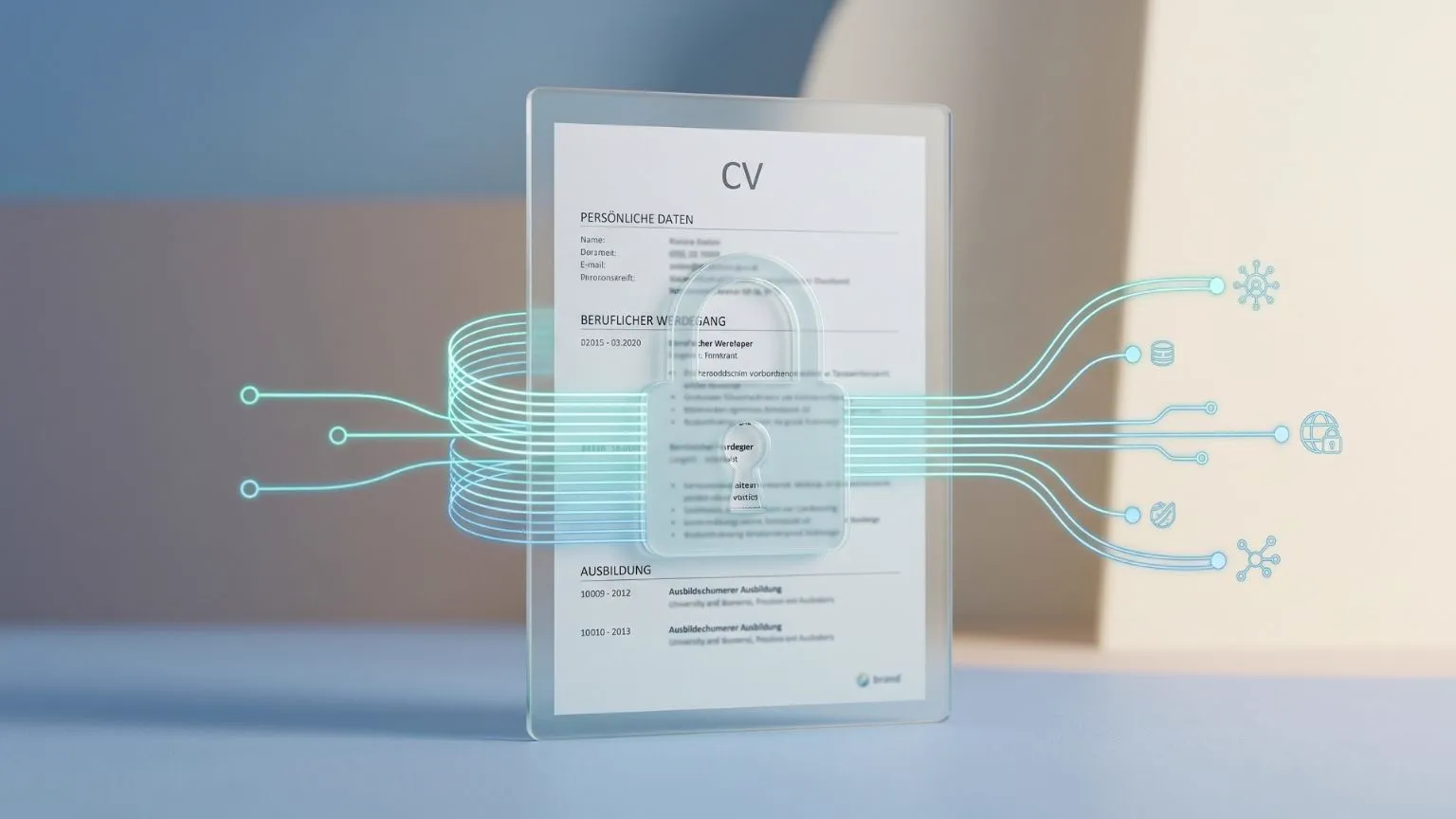
A CV is the densest collection of personal data most people own. Name, address, date of birth, every employer since training, often a photo, sometimes marital status. References and cover letters add details that are specially protected in EU law.
Anyone pasting that bundle into an input field should know what happens next. This article says so, without panic and without glossing over. The framing is in the guide to using AI for your application.
Legal status: August 2026. Orientation, not legal advice.
Your CV is a trove
Take your own document and go through it. It very likely contains:
- Identifying data: full name, address, date and place of birth, phone number, often a portrait photo
- A complete career history: where you were when, for how long, in which role
- Third-party details: names of managers and colleagues from German references, client names from project descriptions
- Possibly special categories: a disability, parental leave implying family circumstances, a union role, a faith-based employer
The last group is the sensitive one. Details about health, religion, origin or union membership fall under Article 9 GDPR as special categories of personal data and may only be processed under narrow conditions.
A portrait photo adds to it: it is a biometric feature, so services generating images from it are processing particularly sensitive data.
What happens to input in general-purpose chats
Three things worth separating.
Storage. What you type usually sits in your history and therefore on the provider's servers, often outside the EU. For how long is in the privacy policy, not in the marketing.
Training. Many providers use free-tier input to improve their models by default and offer an opt-out in the settings. On paid and business tiers it is often the other way round. That is not a scandal, it is a setting, and it belongs checked before you upload anything.
Human review. A share of inputs is read by people for quality assurance. That is in the terms too, and it is why "nobody reads this anyway" is a poor argument.
In practice that does not mean never use it. It means: put in only what you would give an unknown service provider.
The never-list
Five things belong in no stranger's chat, and none of them is needed for phrasing work.
- Health information. Diagnoses, rehabilitation periods, disability status, even when they explain a gap in your CV.
- Religion, origin, political or union affiliation.
- Names and contact details of third parties. Managers, colleagues, clients, referees. They did not consent, and their data is not yours.
- ID, tax and bank details. They have no place in an application anyway.
- Your employer's internal documents. Project names, figures, presentations. Here employment law consequences come on top of privacy ones.
The third line is the one most often missed. Uploading a complete German reference hands over another person's name and signature, usually without a second thought.
Anonymising in 60 seconds
The method is mundane and works immediately.
- Leave out the header block. Name, address, date of birth, phone number, photo. For phrasing work the model needs none of it.
- Replace names with placeholders. "Employer A", "Manager B", "Client C". The text stays comprehensible.
- Take out special categories. Instead of "rehabilitation after a slipped disc", write "health-related break".
- Only then paste. What remains is activities, date ranges, numbers and systems, which is exactly what the model works with.
Getting back is find-and-replace: swap the placeholders for the real names, done. One minute of effort, and the risk drops by a large factor.
The overlooked case: application portals
One point almost always missing from this debate: most of your data does not go to an AI at all, it goes to application portals. Every company you apply to creates a record about you, and many of those sit there longer than you would like.
Your rights apply there too. After a rejection a company may keep your documents only as long as it has a reason to, typically a few months because of potential claims under the German equal treatment act. After that you can request deletion, and many portals offer it directly in the account.
Worth mentioning because the alarm about AI providers often distracts from the larger volume: twenty applications are twenty records at twenty companies you do not know.
How to recognise a good provider
Four questions whose answers should be on the website. If they are not, that is the answer.
Where is the data stored? Processing in the EU is not mandatory but a clear signal. For processing in third countries there has to be a legal basis for the transfer.
Is my input used for training? A clear no or a visible switch. Silence is a yes.
Is there a deletion policy? Not just a "delete account" button but a statement about what happens to uploaded files and generated documents.
Who are the processors? A provider that discloses which services it uses has thought about the question.
On top come your rights, which apply regardless of provider: access under Article 15 GDPR and erasure under Article 17. Both are requested informally. What you can realistically expect: your account and stored inputs disappear, a model already trained does not.
Which tools fall into which category, and what else to check when comparing, is in the article on AI application tools compared.
How Jobvin handles it
The honest part at the end, because a privacy article from a vendor is otherwise worth little.
Jobvin processes your documents in order to generate and store them, and uses language models as processors for that. Your input is not used to train third-party models. There is account deletion, and your documents go with it.
What also belongs here: a service that stores your documents is a risk an empty chat window does not carry. The return is that you do not retype everything for every application. That trade-off is yours to make, not ours. The details, including the uncomfortable ones, are on the data security page.
Frequently asked questions
Does ChatGPT train on my CV?
That depends on the provider and the setting. Many services use free-tier input to improve their models by default and offer an opt-out. Check the setting before you upload, not after.
Can I upload my references?
Technically yes, sensibly rarely. German references carry third-party names and signatures and sometimes details in the specially protected categories. If you need them, redact those parts first.
What does the GDPR require of AI providers?
A legal basis for processing, transparency about what happens, and fulfilment of your rights to access and deletion. Stricter rules apply to special categories under Article 9.
Can I have my data deleted?
Yes, the right to erasure is in Article 17 GDPR. In practice that deletes your account and stored inputs, not a model already trained. Which is why caution beforehand is worth more than a request afterwards.