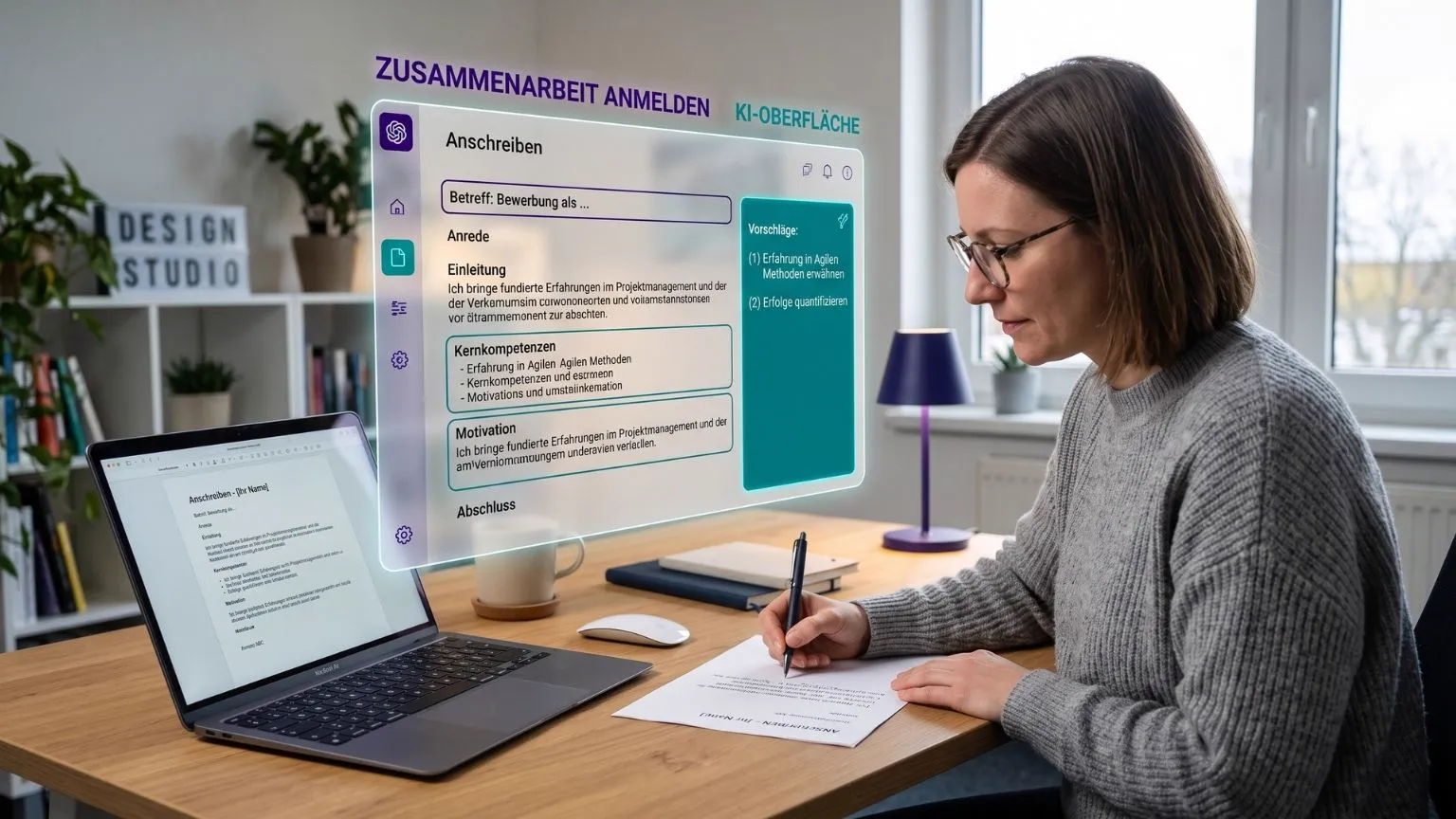
Two questions follow this topic around, and both are rarely answered straight: am I even allowed to? And will anyone notice? The short answers are yes and sometimes. The longer ones are in this guide, along with the part that helps most in practice: a workflow where the AI does what it can do and you do what it cannot.
This text is written by a company that sells AI features. Which is exactly why it also says what AI does badly and where Jobvin runs out. A guide that leaves that out is an advertisement.
How many people actually use AI
Several figures circulate about how many applicants use AI. Two come up most often: a survey by the ifo Institute according to which over 40 percent of job seekers in Germany use AI tools for their documents, and research by the applicant tracking vendor softgarden according to which 43.2 percent use AI for the cover letter, 85.8 percent of them via ChatGPT.
A note on how solid that is, which we owe ourselves: those numbers reach readers almost everywhere through secondary reporting, meaning guide sites citing each other. We could not link the underlying publications at ifo or softgarden in a verifiable form. Treat them as orders of magnitude, not as measurements.
What can be observed independently of any percentage is the effect on the receiving end: German HR teams have reported for about two years a noticeable rise in formally flawless, substantively interchangeable cover letters. That is an observation rather than a statistic, but it matches what anyone sees after reading twenty applications in a row.
The conclusion is the same either way: using AI is normal now, and the vast majority of it runs through a general-purpose chatbot. That explains why so many cover letters sound alike. Standing out is therefore easier than it was three years ago, provided you know where the difference is made.
What AI does well today
Five things a language model does more reliably than most people at 10pm at the kitchen table.
The first draft. The blank page is the most expensive part of any application, measured in hours and postponed evenings. A model gives you a structure with phrasing in seconds. Improving something is far easier than inventing it.
Structure and order. Turning a pile of stations into a sensible sequence, a task list into result lines, five half-sentences into a paragraph. That is routine work, and routine work is the machine's strength.
Finding keywords. A model reads a job ad and reliably marks the terms that matter. For the question of whether your CV survives an applicant tracking system that is directly useful; the background is in the article on the ATS-proof resume.
Translating and shifting register. An English version of your documents, or a paragraph turned from too casual into appropriately formal: both are fast and usually good. For people who have to apply in German in Germany without German as a first language, this is the single largest gain the technology offers.
Answering questions you would rather not ask anyone. What belongs in a German CV, how formal is formal enough, is this phrasing too confident. A chat does not judge, is available at any hour and costs nobody a favour. This benefit is rarely named and for many people it is the real one.
What AI does badly
Three weaknesses are structural rather than temporary. They do not disappear with the next model.
Facts. A language model produces plausible sentences, not true ones. It invents projects, rounds numbers up, turns "contributed to" into "was responsible for". In a cover letter that reads well; in the interview it costs you the job, because somebody asks.
Your voice. Models write in the average of everything they were trained on. The average is smooth, friendly and uniform. That is exactly what HR desks now read twenty times a day.
Overstatement. Left alone, models reach for superlatives. Solid experience becomes "comprehensive expertise", a project becomes a "transformative initiative". Those words say nothing and read as unintentionally comic from someone with five years of experience.
There is also a practical gap: a general chatbot knows neither your CV nor German application conventions, and it remembers nothing. Next letter, you start from zero again.
The German conventions are not a detail here. A model trained mostly on English-language material will reliably suggest things that are unusual or wrong here: an "Objective" at the top of the CV, a list of referees, a cover letter in the American narrative tone, dates in the wrong order. None of that is a spelling mistake, which is precisely why proofreading does not catch it. The person who has seen a hundred German CVs catches it immediately.
And a fourth weakness that rarely gets named: models are agreeable. Ask whether your draft is good and they say yes. An honest "the second paragraph says nothing" only comes if you ask for it explicitly, and even then the criticism tends to be softened. As a reviewer of your own work, a chat is of limited use.
The right workflow
The difference between a good AI-assisted application and an obvious one is not the model, it is the order. This one works.
- Read first, write second. Feed in the job ad and have it tell you which requirements actually carry weight. Without this step the AI writes into the void.
- Supply material. Your real stations, numbers, systems, projects. The more concrete the material, the less the model invents.
- Generate a draft. Structure and phrasing suggestions, not a final version.
- Cut and sharpen. Replace every sentence you would never say. Delete every adjective without evidence.
- Check the facts. Every number, every title, every date range. This is the step nobody may skip.
- Read it aloud. If it sounds like somebody else, it is not yours yet. This step replaces any detector: what you would not say yourself reads as foreign too.
Steps 1 and 5 are the ones that get dropped in practice, and they are exactly the ones that make the difference.
How much time this saves can be roughly quantified. Writing an individual cover letter by hand costs most people between 60 and 120 minutes, most of it on the first paragraph. With this workflow about 20 to 30 minutes remain, and the saving moves from phrasing into selecting. That is the real shift: less time spent on sentences, more on deciding which three arguments matter.
Cover letters step by step
The cover letter is the use case where AI saves the most time and gets noticed the fastest. Both hang on the same point: individualisation.
In practice you give the tool the ad and your profile and have it build a draft. Then you take the core, the two or three paragraphs holding your arguments, and replace every general statement with evidence from your own career.
Here is what that step looks like. The draft says:
Thanks to my many years of experience in customer service I have strong communication skills and a high level of service orientation.
After reworking with your own material:
In the customer service team of an energy supplier I handled around 40 cases a day, a third of them complaints, and for the past year I have run the onboarding for new colleagues.
The same claim, only checkable. The AI could not have written the second sentence, because the numbers were not inside it. They were inside you.
Then the opening. It decides whether the rest gets read, and it is where generated texts are palest. How a good first sentence is built, and how the letter is put together as a whole, is in the cover letter guide.
Anyone doing this often notices where a general chat runs out: it does not know your history and knows German conventions only by hearsay. Jobvin's AI cover letter starts there, because profile and posting go into the draft together. It still returns a draft rather than a final version, and that is not modesty but design: what you have done is something only you know.
Optimising a CV with AI
With the CV the task is different. It is rarely about writing and almost always about rewriting: turning task lists into results, passive constructions into actions, a wall of text into a structure readable in five seconds.
Models are well suited to that, because the material already exists. They invent less when asked to rewrite rather than to produce. The fundamentals are in the German CV guide, the tool at AI resume.
Two things you always check yourself afterwards. First the date ranges: models like to smooth dates when they see a gap. Second the titles: a promotion that never happened is not a phrasing question.
A third point concerns tailoring. It is tempting to optimise the CV once and send it everywhere. The opposite works: keep a maintained base version and derive a tailored variant per application. After the first time that costs a few minutes, because only the summary and the order of the result lines change.
Allowed, welcome, detected?
Three questions come back constantly, and each deserves its own article in this cluster.
Allowed? No law forbids you from using a tool. What does exist is the duty not to state false facts. Inventing a degree on your CV is a problem regardless of who typed the sentence.
Welcome? That is the employer's call, and views differ. Some postings explicitly ask for a self-written motivation letter. What is meant is the content, not going without a spell checker. Worth knowing: many companies use AI in their own pre-selection while viewing it critically on the applicant side. You cannot resolve that asymmetry, but you should know it, because your documents will very likely be read by a machine first.
Detected? More often than AI users think, and less often by software than by pattern. So-called AI detectors are unreliable and produce false positives, particularly for non-native speakers. What actually stands out is a text without a single concrete sentence.
For everyday purposes it reduces to one question: does your letter contain at least one sentence no other applicant could have written? If yes, the detection question is settled, whatever tool was involved. If no, a handwritten text does not help either.
Privacy: what never goes into a stranger's chat
A CV is one of the densest collections of personal data a person owns: name, address, date of birth, career, often a photo. Cover letters and references add information that counts as specially protected in EU law, such as health or religion.
Four rules that cost little:
- Nothing about third parties. Names of colleagues, managers or clients do not belong in an input field. They did not consent.
- No special categories. Illness, disability, religion, union membership. If a paragraph mentions them, take it out before the rest goes in.
- No ID or bank details. They have no place in an application anyway.
- Know what the provider does. Does it train on your inputs? Where is the data stored? Is there a deletion policy?
Anonymising takes under a minute: replace names with placeholders, take the address and date of birth out of the text, put the rest in. For phrasing work a model does not need your name, it needs your activities.
How Jobvin handles this is on the security page, including the parts that are not sales arguments.
Where AI is no help at all
Three parts of an application stay manual, and it is worth knowing that early rather than expecting otherwise.
Choosing which jobs to apply for. Whether a role fits you is decided by things that appear in no advertisement: the team, the manager, the commute, how you want to work in five years. A model can tell you whether your keywords match the ad. Whether the job matches your life, it cannot.
Your network. A substantial share of roles is never advertised. The route there runs through people, and a call to a former colleague cannot be substituted.
The interview. AI can help you prepare and rehearse. In the room you sit alone, and everything in your documents has to be explainable there. Which is, incidentally, the most practical reason not to leave invented numbers in.
The tools, honestly
The market splits into three groups, and each has its place.
General-purpose chats are free or cheap, flexible and available in seconds. They do not know your CV, remember nothing, produce no finished PDF and know little about German application norms. For a rough draft they are entirely fine.
One criterion that rarely appears in comparisons and matters a lot in practice: the export. A tool that hands you an image PDF or a web page has not helped you, because tracking systems read text. Before paying, check that you get a real text PDF you can copy paragraphs out of.
Resume builders provide layout and export, often with templates. Their AI features are usually limited to phrasing help, and many are built for the Anglo-American market, where different rules apply.
Application platforms like Jobvin connect profile, job ad, documents and follow-up. The advantage is that the AI works with your actual material and the results stay in one place. The downside: you create a profile, which is more effort than opening a chat window, and it only pays off beyond two applications.
What honestly belongs in this list too: no tool replaces choosing the right roles and following up. What hangs together there is laid out in the career tools overview.
And what also belongs here, or it reads as advertising: Jobvin does not decide which jobs you apply for, and it does not sit in your interview. It offers no guarantee of invitations, and it does not know your labour market better than you do. What it does is make the mechanical part faster and stop things from slipping.
The five most common mistakes
- Sending the draft unchecked. The most expensive and most common. A generated text is a shell, not a product, and the difference is ten minutes of work.
- Supplying no material. Feeding in only the job ad and saying "write me a cover letter" produces a text about the role, not about you.
- Keeping numbers you cannot verify. Models invent percentages because percentages sound convincing. Somebody asks in the interview.
- Sending the same version everywhere. The time saving tempts you into volume. Ten identical applications are worse than four tailored ones, and together they cost more time than the four.
- Typing sensitive data into a stranger's window. References contain other people's names, letters sometimes contain health information. Both come out before the rest goes in.
What stands out when you line the five up: none of them is a problem with the technology. All five come from spending the time saving immediately instead of putting it into quality.
In the end one rule of thumb survives. The AI is a very fast intern with a good ear for language, no memory and no scruples about inventing things. You give someone like that material and let them produce a draft. You do not let them sign it.
If you take one sentence from this guide, take this one: the value of AI in an application does not come from where it writes, it comes from where it frees up time for the decisions only you can make.
Frequently asked questions
Is using AI a form of deception?
No, as long as the content is true. Using a tool is not deception, false statements are. The line does not run between human and machine, it runs between true and invented.
Can recruiters tell a ChatGPT text?
Often yes, and not through software but through the pattern: the same rhythm, the same transitions, many adjectives and little that is concrete. A text with real numbers and your own examples does not stand out.
What data may I give an AI?
Anything you would give an unknown service provider. What does not belong in there: health information, religion, bank details, and personal data about other people, such as colleagues named in your references.
Does AI replace thinking it through?
It replaces the blank page, not the decision. Which three arguments belong in your letter is something only you know, because only you know your career. The AI phrases, you select.
What does Jobvin's AI cost?
There is a free tier and a paid one for the fuller feature set. The current terms are on the pricing page, so they do not go stale here.