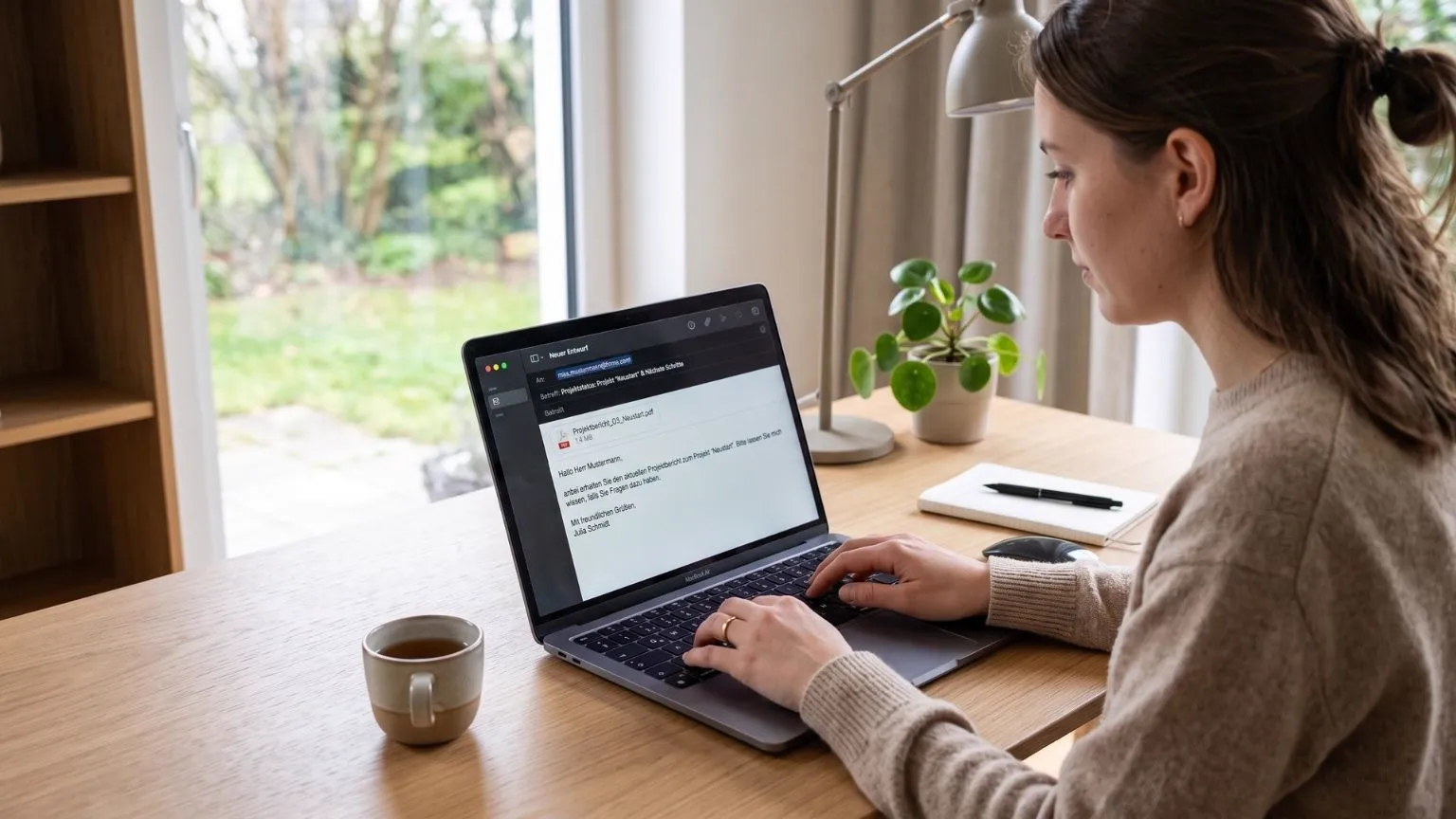
With an email application the cover letter gets reworked and the email itself typed in thirty seconds. Yet the email decides first: it determines whether the attachment is opened at all, and it is the only part of your application the recipient sees in their list.
This article covers subject line, body and attachment. The process around it is in the complete application guide.
The email is the first impression
Picture the inbox on the other side: a list of sender, subject and date. That is all the recipient sees at first, and from those three the decision comes whether to open now, later, or never.
Three things follow. The sender address should be your first and last name; nicknames from school are the cheapest avoidable mistake. The subject line has to name the role. And the body may be short, because the arguments sit in the attachment.
A subject line that gets found
The subject has two jobs: it places the email immediately and makes it findable later. The same pattern achieves both.
Bewerbung als Sachbearbeiterin Einkauf, Kennziffer 2026-441
That is all. No "Application", no "My documents", no greeting, no exclamation marks. If the ad names a reference number it belongs in there, because larger companies sort by it.
Two variants are fine too: adding your name ("Bewerbung als Disponent, Kennziffer 441, Meier") and referring to a contact ("Bewerbung als Erzieherin, nach Rücksprache mit Frau Keller"). The second is strong, because it explains at once why the email is arriving.
What never belongs in the subject: the job title in your own words. If the ad says "Fachkraft für Lagerlogistik" and you write "warehouse worker", the search will not find you. Keep the German title exactly as advertised, even in an otherwise English application.
The body: a summary, not a copy
The most common mistake is pasting the cover letter into the email. Then the recipient reads the same text twice, or more likely once, halfway.
Three to five sentences are enough:
Sehr geehrte Frau Berger,
auf Ihre Ausschreibung als Sachbearbeiterin im Einkauf (Kennziffer 2026-441) bewerbe ich mich gern. Ich arbeite seit sechs Jahren in der Beschaffung eines Zulieferers mit drei Standorten und bringe Erfahrung mit SAP MM mit.
Anschreiben, Lebenslauf und Zeugnisse finden Sie im angehängten PDF. Für Rückfragen erreichen Sie mich unter 0170 1234567.
Mit freundlichen Grüßen Anna Meier
What that text does: names the role, delivers one sentence of substance, says what is attached and how to reach you. What it does not do: argue. That is the cover letter's job.
A signature with your name, phone number and, if you have one, a profile link goes underneath. No images, no quotations, no coloured fonts.
Attachment rules
One file. All documents in one PDF, in the order cover page, letter, CV, references. Five separate attachments mean five downloads and five chances to lose something. Whether a cover page makes sense at all is covered in the article on the German cover page.
A sensible file name. "Meier_Anna_Bewerbung_Sachbearbeitung.pdf". The name lands in a folder with thirty other files, and there it decides findability.
A real text PDF. Not an image PDF made of photographed pages. The copy test is the simplest check: if you cannot select and copy a paragraph in the finished PDF, it is a blank page to any applicant tracking system.
Under ten megabytes. Scanned references are the usual cause of oversized attachments. Scanning at 200 to 300 dpi in greyscale is plenty; anything more inflates the file without improving legibility.
No password protection, no ZIP file. Both produce exactly one reaction: the email gets set aside.
Whether your documents need a signature and what else is formally expected is in the article on signing your CV.
The seven-point check
Two minutes before sending:
- Is the recipient right, and is the name spelled correctly?
- Does the subject contain the role and reference number?
- Is the attachment actually attached? The classic failure.
- Is the file named after you?
- Can you select text in the PDF?
- Is there a phone number in the email?
- Is the previous company's name still somewhere in the text?
Point 7 is the most expensive. Anyone building several applications from one template eventually leaves a company name standing, and that reliably produces a rejection. A glance at subject, salutation and first paragraph catches it.
Send the finished email to yourself and open it on your phone. Twenty seconds there show you how it arrives.
Special cases
Applying while employed. Not from the work computer and not from the company address. That is not a minor slip: in many companies it breaks the acceptable use policy, and the sender address gives you away in passing.
Several roles at the same company. One email per role, not one email with two subjects. The processes run separately internally, and a combined message lands in one of them or in neither.
A shared inbox instead of a named contact. If only "bewerbung@" is given, you still write a personal salutation where you can find a name. If you cannot, the general salutation stands; that beats a guessed name.
The ad demands a form. Then use the form, even where email would be more convenient. Bypassing the stated route creates a special case for the HR team, and special cases get sorted to the back.
After sending
An acknowledgement arrives automatically at larger companies and not at all at smaller ones. Neither says anything about your chances.
Log the application immediately with date, company, role and channel. If nothing comes after about two weeks, following up is due, and then you need exactly those details. Where versions and attachments come together, so that four weeks later you still know which PDF went where, is what application documents is for.
And a last point that saves nerves: an email that never arrived looks exactly like one that was ignored. If you get no reaction after following up, check once whether the address from the ad is correct. A typo in the recipient address is more common than indifference.
Frequently asked questions
How should I name the PDF?
Following the pattern "Surname_Firstname_Bewerbung_Position.pdf". The recipient saves it into a folder with thirty others; a file called "application_final_2.pdf" is unfindable there.
How large may the attachment be?
As a rule of thumb under ten megabytes, ideally under five. Many company mailboxes reject larger attachments, and sometimes you never find out.
Does the cover letter go in the email or the attachment?
In the attachment, together with the rest. The email body is a three sentence summary, not a copy of the letter. Only different if the ad explicitly asks otherwise.
What time should I send?
On a weekday, in the morning. An application arriving at 3am gets read like any other, but it slides down the inbox before anyone looks.