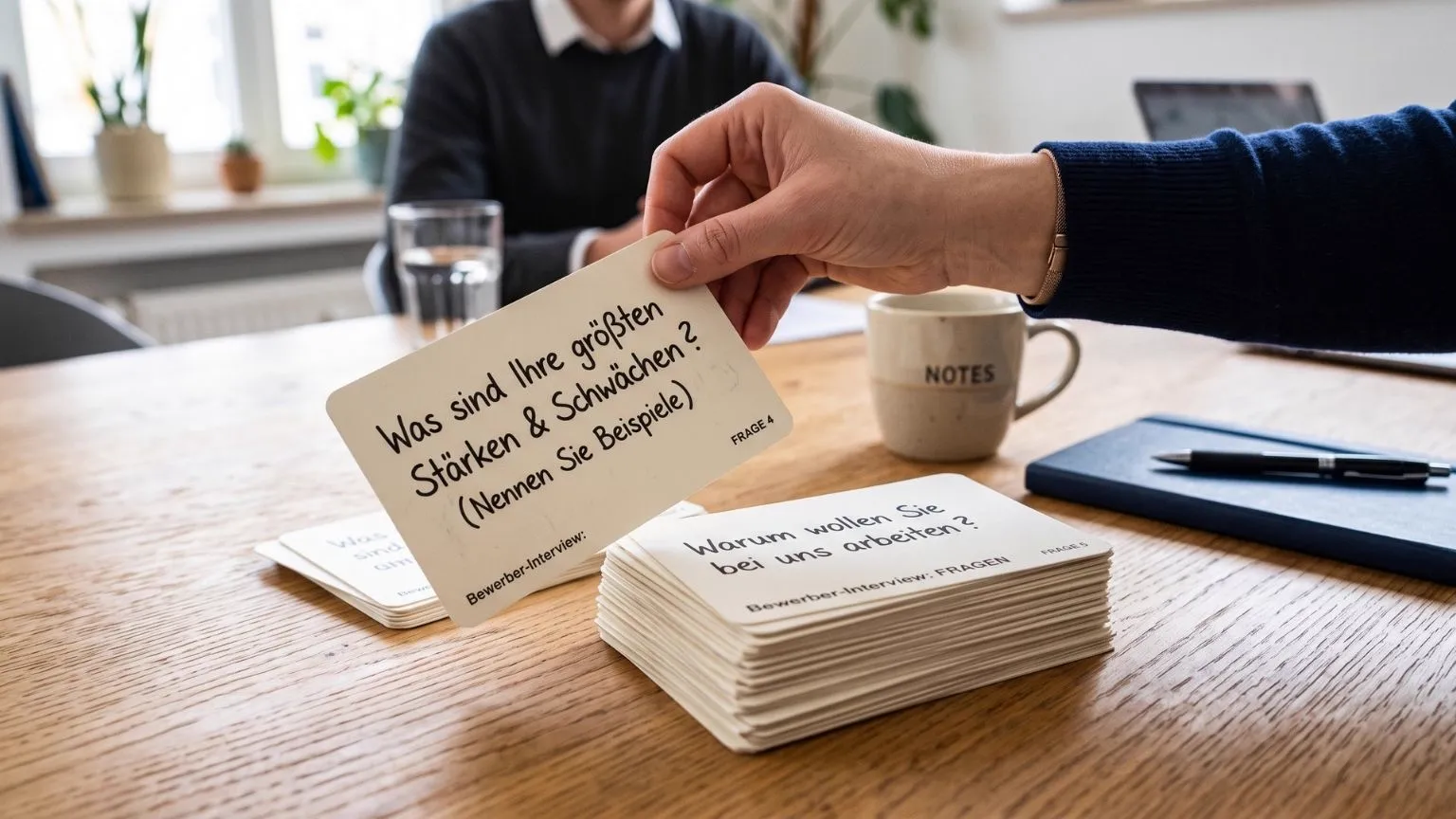
There are interviews in which not a single surprising question comes up, and people still walk out without an offer, because they treated the predictable questions as a warm-up and only started thinking when the hard one arrived. It works the other way round: the standard questions sit, and your head stays free for whatever was not in the script.
Below are the fifteen questions that appear in almost every German interview, what each one really tests, and a frame you fill with your own examples. How an interview runs as a whole is in the interview preparation guide.
The opening: the first few minutes
"Erzählen Sie etwas über sich" (tell us about yourself). The most common question anywhere and the worst prepared. Nobody is testing your Lebenslauf (CV); your counterpart has it. They are testing whether you can draw a line through your career and know which part matters here. The frame: where you come from professionally, what you do now, why you are sitting here. Two minutes, and the last sentence builds the bridge to the job. Start chronologically with school and you will have reached nobody four minutes in.
"Warum wollen Sie wechseln?" (why are you moving?). This tests risk. Your counterpart is looking for a conflict that might repeat itself here. So the answer runs towards something, not away: say what you are looking for, not what you are sick of. One sentence on the trigger is enough, and nobody speaks badly about a former employer here. After a dismissal or a gap, the same rule in shorter form: factual, no apology.
"Wie sind Sie auf uns aufmerksam geworden?" (how did you hear about us?). It sounds polite. It is a test: did you apply, or did you scatter? Name the channel and one detail that stuck with you.
Motivation: why us in particular
"Warum wollen Sie zu uns?" (why join us?). This tests whether your reasons fit this company or any company. "Because you are the market leader" is true of every market leader. Build the answer in three parts: one thing about the company, one about the work, one link to your own path. Most people leave out the third, and it is the part that makes the answer yours.
"Was wissen Sie über uns?" (what do you know about us?). What counts is whether you got past the homepage. The business model in one sentence, then something current: a product, a new site, a piece of trade press. Then stop, or it turns into a lecture.
"Warum genau diese Position?" (why this role?). The test is whether you read the advertisement or only the job title. Take two tasks from the ad you have demonstrably done, and one you want to learn.
Competence: the questions that want examples
"Was sind Ihre Stärken?" (your strengths?). Three strengths without evidence is self-description; one with evidence is information. Take the strength the advertisement keeps circling back to and attach a situation where it made a difference.
"Was ist Ihre größte Schwäche?" (your biggest weakness?). This tests self-assessment, not flawlessness. Disguised strengths such as "I am too much of a perfectionist" have been burnt for years and are heard as evasion. Name a real weakness that is not central to this role, then say in the next sentence what you do about it. That second sentence is the one that counts.
"Erzählen Sie von einer schwierigen Situation" (a difficult situation). This is the actual examination question, in variants: a team conflict, a project that tipped over, an unhappy client. What is wanted is a story with an action and a result, not an attitude. The simplest frame is the STAR method: situation, task, action, result, in that order. Stop before the result and you have not answered.
"Wie gehen Sie mit Kritik um?" (how do you take criticism?). Nobody wants a pledge of willingness to learn, they want a case. Describe feedback you actually received, your first reaction, and what changed afterwards. Anyone who has never had uncomfortable feedback has never carried responsibility.
The future: where the interview is heading
"Wo sehen Sie sich in fünf Jahren?" (five years from now?). Not aimed at a career plan, aimed at retention. Your counterpart wants to know whether this role is a stopover. Answer in capabilities rather than titles: what do you want to be able to do, and why here? Honest, without committing to a position that may not exist there.
"Was sind Ihre Gehaltsvorstellungen?" (salary expectations?). Name a range, not a point, with one sentence of reasoning: scope, responsibility, market level in your region. Keep the range tight or you negotiate against yourself. And say it without hesitating and without adding that everything is negotiable.
Pressure questions: what they actually measure
These three rarely come early and never wrapped kindly. They measure how you react when the room gets uncomfortable.
"Warum sollten wir Sie nehmen?" (why you and not someone else?). You do not know the others, so do not compare. Take the two heaviest requirements in the advertisement and show you have delivered both.
"Was war Ihr größter Fehler?" (your biggest mistake?). The test is whether you take responsibility without falling apart. A real mistake, one sentence on the consequence, two on what you made of it. Nothing from your private life, and nothing where somebody else turns out to be at fault.
"Was würden Ihre Kollegen an Ihnen kritisieren?" (what would colleagues criticise?). The weakness question from the side. Give the same answer as above from someone else's perspective, and do not contradict yourself. That is exactly what is watched.
Questions they may not ask, and how to respond
Not every question has to be answered. The employer's right to ask ends where the answer says nothing about the job and reaches into protected characteristics. The Allgemeines Gleichbehandlungsgesetz, Germany's equal treatment act, prohibits discrimination on grounds of gender, age, origin, religion, disability and sexual identity. Less favourable treatment because of pregnancy counts explicitly as gender discrimination under section 3 AGG.
Three classics. Questions about pregnancy and family planning are not permitted, including for fixed-term roles and including when they arrive dressed as concern. Questions about illness are permitted only where a condition permanently rules out the specific work or would infect colleagues and customers; sick days and diagnoses in general do not. Questions about union membership, party or religion are not permitted either, and freedom of association sits in article 9 of the Grundgesetz, the German constitution.
Which leads to something many applicants do not know: you may answer an impermissible question untruthfully. The employer cannot later void the contract for fraudulent misrepresentation under section 123 BGB, because the question should never have been asked. This does not extend to permissible questions. None of this is legal advice and borderline cases exist, but the direction holds.
In the room you have four options. Answer, if the question does not bother you. Redirect to the factual core: "Meine Verfügbarkeit ist unbeschränkt" (my availability is unrestricted). Say you would rather not answer, which is your right and still costs goodwill. Or answer untruthfully. Which one you pick depends less on the law than on whether you want to work in that building.
Practising without sounding rehearsed
The mistake when practising is learning sentences. Memorised text is audible immediately, and the first follow-up brings the structure down. Learn examples instead: five to seven stories from your working life cover almost every competence question, and you only cut them to fit.
Three things separate a thought answer from a spoken one. Speak out loud, because in your head every answer is fluent. Record yourself once and listen back; unpleasant, and faster than any guide. And time it, because answers get longer under pressure, not shorter.
Fix only the first two sentences of each answer and leave the rest free. The opening is where nerves show; once it holds, the rest carries itself. One aside: "Haben Sie noch Fragen an uns?" (any questions for us?) has exactly one correct answer, and it is yes.
If you have nobody to ask the follow-ups, the job check takes that over. It puts the questions for your role to you, and for every answer you write down you see where it went thin. That is the part you cannot tell yourself.
Frequently asked questions
How long should an answer be?
Sixty to ninety seconds for most questions, up to two minutes for the self-introduction. Once you notice you are explaining rather than telling, you have gone past the point. Better to answer briefly and invite a follow-up than to fill the room alone.
What do I say to the salary question?
A range with one sentence of reasoning, not a single figure and never "that is negotiable". Whoever names a number first sets the frame, and that is no disadvantage as long as the number follows from the scope of the role and the regional market.
Can I defer a question?
Yes. "May I come back to that at the end, once I know more about the role?" is a grown-up answer, provided you actually do come back to it. It does not work twice; the second time it reads as evasion.
What do I do if my mind goes blank?
Say it out loud instead of stammering half a sentence. "One moment, I want to answer that properly" plus three seconds of silence reads as composed. If nothing comes at all, repeat the question in your own words, which usually brings the thread back.