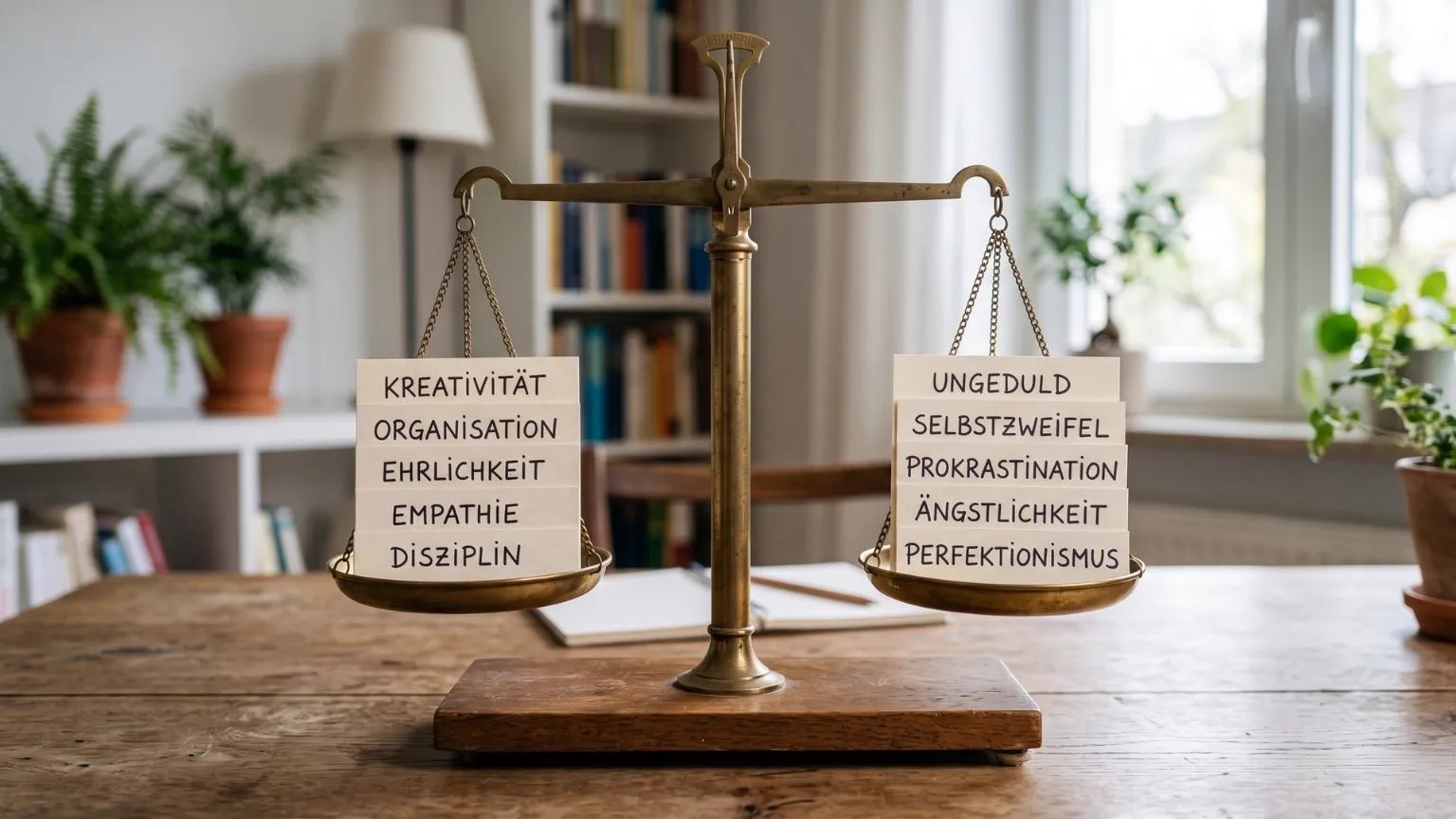
Two questions get more preparation than any others, and the answers still come out identical. "Was sind Ihre Stärken?" (your strengths) produces three adjectives. "Und Ihre Schwächen?" (your weaknesses) produces perfectionism. Both are memorised, both were seen through years ago, and both waste the one minute in which you could say the most about yourself.
This article covers what the question actually tests, how to prove a strength instead of claiming it, and what a real weakness sounds like without tripping yourself up. Where it sits in the flow of a German interview is in the interview guide.
Why the question refuses to die
It is in every guide, everybody knows it is coming, and it comes anyway. The reason is uncomfortable: it costs nothing to ask and reveals a lot. Not about your strengths, but about how you see yourself.
Three things are being checked: whether you can assess yourself without inflating or shrinking the picture, whether you can talk about your own work without sliding into advertising language, and whether what you name fits the role you are sitting there for.
That is also why the weakness question is not a trap. It would be a trap if an honest answer got you filtered out. What gets filtered out is the evasion: it shows you either never thought about yourself or do not trust the person opposite to handle an ordinary human flaw. Both weigh more than any real weakness.
One point specific to Germany: the expected register is sober. Energetic self-selling of the kind that works in other markets reads here as noise, while understatement with a concrete example behind it travels far. Which other questions reliably turn up is covered in the typical interview questions.
Naming a strength with proof
An adjective is not a strength, it is a claim. Anyone can say "team player", including people who are not. What turns the claim into a strength is the story behind it, and that fits into three sentences.
Strength, then situation, then result. First sentence: what the strength is called. Second: where it showed, briefly, with a place and a time. Third: what came of it, in a form somebody could ask about.
Out loud, that sounds like this:
I work in a structured way. In my last job, complaints arrived through four channels: email, phone, the portal and on paper. I turned that into a list with fixed processing steps, and nothing has been left lying around since. My colleague took over during my parental leave without any training.
I stay calm when things get tight. On our ward, somebody dropped out at short notice twice in one week on the late shift. I redistributed the round and called the unit manager before it started. We got through both times without overtime.
I pick up new things quickly. During my internship I had to adapt a script in a language I had never used. Two days later the change was running, and I wrote a page of documentation for it, because there was none.
Three things make these answers work. The strength comes first, so the person opposite knows what to listen for. The situation stays small and concrete. And the result is checkable, rather than "it took a huge load off the team".
Two strengths are enough. Pick them by what the ad asks for, not by what sounds impressive: if it wants independent working, tell that story and not the one about your creativity. The same selection applies to the skills in your Lebenslauf (the German CV), see skills on your resume.
If you need the longer form, say for a question about a specific conflict or project, use the STAR method. The three-sentence formula above is its short version.
The weakness trap: "perfectionism" and other non-answers
Do not say it. "I am a perfectionist" is the most-heard answer to this question, and it long ago stopped being heard as a weakness. It reads as an evasion with a compliment smuggled inside. The same goes for its siblings:
- "I work too much."
- "I am too honest."
- "I find it hard to say no."
- "I get impatient when others are slower."
All four dress a strength up as a flaw, and all four do more damage than an honest answer. The damage is retroactive: somebody who dodges here may well have embellished the strengths too. That is the thought the sentence sets off.
The second non-answer is "I cannot think of one right now". It sounds like a lack of preparation, and usually it is.
That leaves the other extreme, where courage stops being useful. A weakness that lands on the core requirement of the role costs you the role. Declaring yourself imprecise in an accounting job, or admitting in a service role that you would rather not deal with people, is not honesty but self-rejection.
Showing a real weakness with composure
The formula is shorter than for strengths: weakness, then how you handle it. One sentence names the weakness, one or two show what you do about it. What you already do, not what you intend to start.
I get nervous in front of larger groups. So I write out the first two sentences word for word and run through the presentation out loud once. The beginning is the problem, after that it flows.
For a long time I did too much myself instead of handing it over. In my last role I passed on fixed tasks and trained myself to check the result, not every intermediate step. That took practice.
With long lists of figures I miss errors on screen. So I have the totals cross-checked and read the final version once on paper. No transposed digit has slipped past me since.
Why this holds up: the weakness is real and therefore believable, the handling is concrete and already running, and the answer ends after three sentences, with nothing added on, no apology, no second weakness for safety.
Two limits. Health does not belong here: a diagnosis is not a weakness in the sense of this question, and you do not have to disclose it in an interview. And things a single decision would fix, such as lateness or a chaotic desk, do not sound honest, they sound untidy.
Finding strengths when none come to mind
The most common reason this preparation stalls: people go looking for adjectives. Nobody can think of adjectives on demand, but everybody can think of situations. So reverse the order.
Step 1: collect three moments. Think back over the last year: something went well, somebody thanked you, or you were asked because you can do it. Write each down in two lines, without judging it.
Step 2: find the verb. What did you do in those moments? Sorted, explained, calmed, prepared, followed up. That verb is the strength. "I wrote up the handover for my stand-in" becomes "I work in a structured way".
Step 3: ask two people. Colleagues, a former supervisor, someone from a volunteer role: "what would you bring me in for?" The answer is almost always sharper than your own picture.
Step 4: hold it against the ad. Out of five pieces of proof, the two that fit the role survive. The rest are not wasted, they go into the collection for next time.
That collection is what the Story Bank is for: you write each story down once, in the five fields of the STAR method, and find it again before the next one.
The short version for the night before
If the interview is tomorrow and you need one page:
- Two strengths, each with a three-sentence example: strength, situation, result.
- One weakness, a real one, plus a sentence on what you do about it. Not perfectionism.
- No chains of adjectives. One word for the strength, then the story.
- Nothing learned by heart, only the three anchor points per example. Memorised answers are audible, and the first interruption wipes them out.
Which leaves the point where most preparation evaporates: answers that look good on paper often sound different out loud. Say each one aloud once before it counts.
Frequently asked questions
How many strengths and weaknesses should I give?
Two strengths and one weakness is the safe amount. More strengths dilute the answer, because the example behind each one goes missing; more weaknesses read like a confession. If you are explicitly asked for two weaknesses, keep a second one ready and treat it just as briefly.
Is impatience a good weakness?
Only if you mean it and are not selling praise in disguise. "I get impatient when others are slower" is self-congratulation. "I cut people off as soon as I think I have the point, and I now have my team flag it" is an answer. The test is whether the weakness costs you something or costs everyone else.
Does a weakness have to be unrelated to the job?
It does not have to be far away, it just must not sit in the core task. For a customer-facing role you can name nerves before a large audience, but not that conversations are generally hard for you. Check your answer against the ad: if your weakness is listed there as a requirement, find a different one.
Can I answer with humour?
A dry aside is fine and often loosens the room, a joke as the whole answer is not. Laughing the question off does not answer it, and the follow-up comes anyway. You are safe when the humour sits in the tone and the substance stays intact.