The email arrives on a Tuesday morning: thank you for your interest, we have decided in favour of another candidate, we wish you all the best for your future career. Two sentences, no reason, nothing to work with. And you are left with the one question the text does not answer: was it you?
This article deals with what actually matters afterwards, which is what you do with the rejection. How the whole path from search to offer is built in Germany is in the complete application guide.
A rejection is a data point, not a verdict
A rejection says exactly one thing: for this role, at this company, at this moment, somebody else was closer. It says nothing about whether you can do the job, and even less about what you are worth. The information content of a single rejection is close to zero, because you have no idea who you were up against.
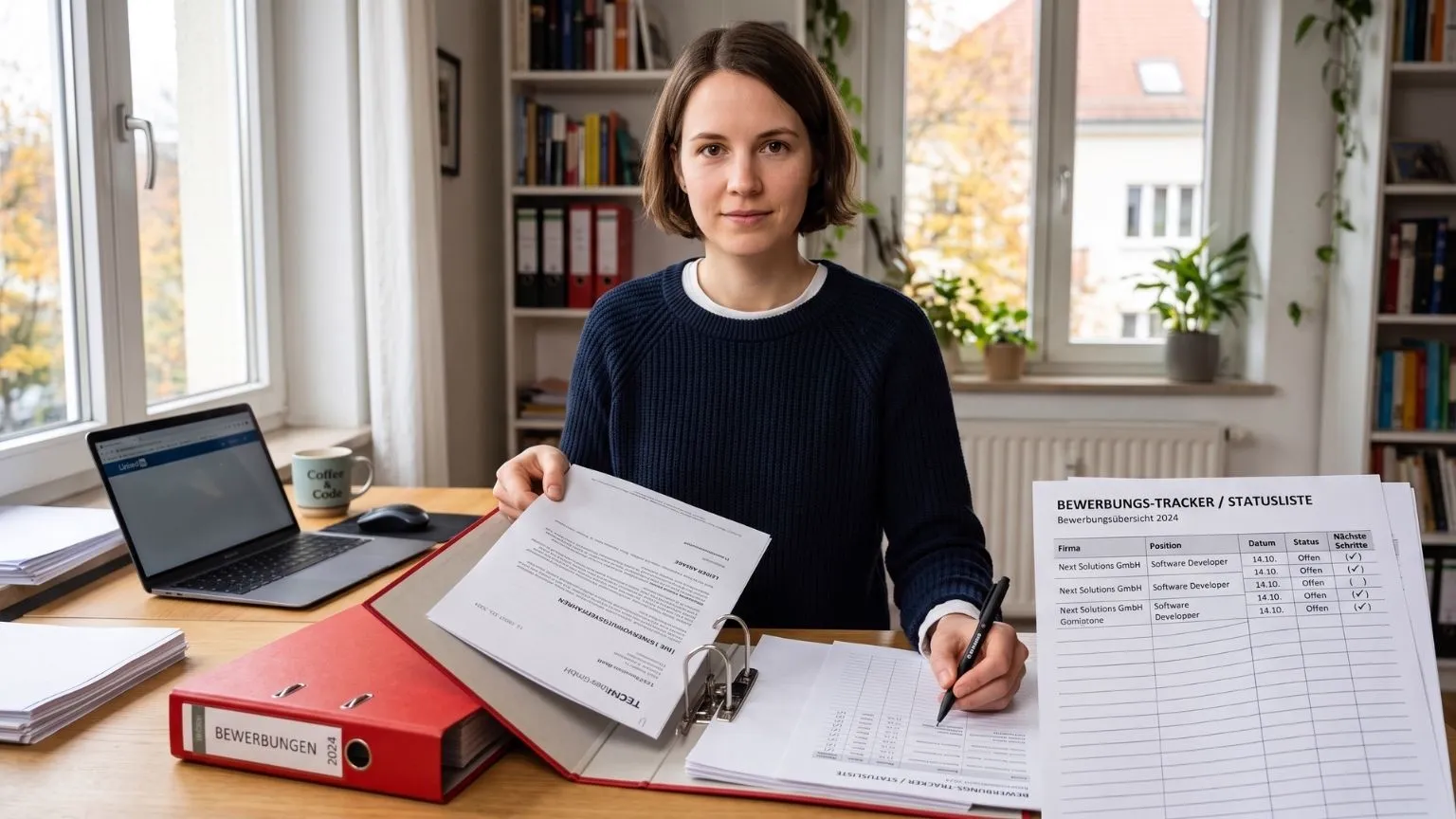
Ten rejections laid side by side, though, carry a lot of information. That is the step most people skip: turning the rejection from a verdict into an entry. An entry has a date, a company, a stage and an outcome. A verdict only has a feeling.
That sounds unsentimental, and it is meant to. Taking every rejection personally spends your energy exactly where it changes the least.
The numbers behind it: how many applications before an offer is normal
Data from the employer survey run by the Institute for Employment Research (IAB, the research arm of the German Federal Employment Agency) puts this in perspective. According to the IAB job vacancy survey, one hire draws an average of 18 applications, of which employers rate only around 5 as suitable at all. Large companies could choose from roughly 39 applications per hire, small and micro businesses from 5 to 6.
Turn that around: if 18 people apply and one gets the job, 17 rejections are the normal case, not the exception. And among those rated suitable, four out of five are still turned down. Being qualified is not enough, you have to be the strongest on the day, and that is a question of who else showed up rather than of your ability.
Two things do not follow from these figures. First, this is not a personal quota: the numbers are per vacancy, not per applicant. Applying selectively to roles you genuinely fit takes far fewer attempts than spraying applications around. Second, the spread by company size is so wide that choosing your target employers matters more than any phrasing in your cover letter. At a small firm you are up against a handful of people, at a corporate group against many times that.
Asking for feedback you actually receive
Most rejections stay empty, and that is no accident. In a survey of more than 1,100 candidates by softgarden, 73 percent called comprehensible reasons for rejection very important, while only 22 percent had actually been given any. Only every second candidate received a timely response at all.
You can ask, but not with the question everybody asks. "Why was I rejected?" is too open and invites the standard reply that decisions are not commented on. Ask narrowly, optionally, and pointed forwards instead:
Guten Tag Frau Berger,
vielen Dank für Ihre Rückmeldung zur Stelle als Sachbearbeiterin im Einkauf.
Ich bewerbe mich weiter in diesem Bereich und möchte meine Unterlagen schärfen. Deshalb nur eine einzige Frage: Hat Ihnen eher etwas Fachliches gefehlt, oder war jemand anderes schlicht passender?
Über zwei Sätze freue ich mich sehr. Wenn es zeitlich nicht passt, habe ich dafür ebenfalls Verständnis.
(In English: thanks for your reply on the purchasing administrator role. I am still applying in this field and want to sharpen my documents, so one question: was something missing on the technical side, or was somebody else simply a better fit? Two sentences would mean a lot; if there is no time, I understand.)
Why this works: it is one question rather than three, it is nearly a multiple-choice item, it contains no criticism of the decision and no plea to reconsider. Answering costs the recruiter twenty seconds.
Two more notes. Send it within a few days, after which the case is closed in the other person's head. And expect far more replies after an interview than after a rejection at the document stage: somebody who met you has something to say. How to follow up before the rejection, without becoming a nuisance, is in the article on following up.
Spotting the pattern: which stage is failing?
Here is the part that genuinely changes something. An application has stages, and the one where it breaks off decides what you need to work on. These are two completely different jobs, and they get confused constantly.
You are not invited. Then it is the documents or the choice of roles. The Lebenslauf (the German CV, a structured tabular document) is hard to scan, the cover letter fits any advert, the keywords from the posting appear nowhere, or you keep applying to roles where a core requirement is missing. Rebuilding the documents pays off here.
You are invited, then rejected after the interview. Then the documents work. They got you into the room, that is their job, and they did it. The work lies after that: in the examples you tell, the questions you ask, how you handle weaknesses and salary. Rebuilding your CV for the fifth time in this situation optimises the wrong thing and costs you months.
A third variant gets overlooked: nothing comes back at all, not even an acknowledgement of receipt. Before you conclude anything about yourself, check the mechanics. Wrong address, an oversized attachment, a portal that never saved the submission.
To see the pattern you need the data, from the start. The application insights work exactly that out from the applications you logged: how many lead to an interview, how many go further, and at which stage the curve drops off.
Rejection reasons that have nothing to do with you
Part of every decision happens in places you have no access to:
- The role was filled internally long ago and the posting was a formality. In the public sector and at companies with works council agreements, this is routine.
- A hiring freeze or a budget cut landed in the middle of the process.
- Somebody from the network applied in parallel, with a referral.
- The role was recut, and suddenly leadership experience is required.
- You read as overqualified and the company fears you will leave within a year.
- You were strong, but the offer already sat with somebody who entered the process two days earlier.
None of these ever appears in a rejection letter. That is precisely why it reads so empty.
One honest caveat: it would be comfortable to file every rejection in this box. That is the other extreme and just as unhelpful, because then you never change anything. The distinction does not come from the single letter, it comes from the pattern across several applications.
Staying with it by system rather than by willpower
What holds up in practice is a short fixed routine rather than grand resolutions.
Close it the same day. Read the rejection, note the date and the stage, file it, done. No second reading in the evening.
Send one application after it. Not out of defiance, but so the sequence continues instead of ending on a full stop. It is the single most reliable way to get your head moving again.
Look at the list once a week, not after every rejection. One data point carries no decision. Twenty minutes on the same weekday is enough.
Change one thing at a time. Rebuild photo, layout and opening at once and you will never know which one worked. Change one thing, let it run for a few applications, then judge.
Plan the breaks. Two weeks without an application is not a setback. What hurts is grinding on at half strength for weeks and then treating the rejections as a verdict on yourself.
The point of the routine is not good spirits. It is that the next application is better than the last one, and for that you have to know what the last one did.
Frequently asked questions
Do I have a right to be told why I was rejected?
No. German law gives you no general claim to a reason for a rejection. Only where there are concrete indications of discrimination on one of the grounds listed in the AGG (the General Equal Treatment Act) does a separate procedure with short deadlines apply. This is not legal advice: if you suspect discrimination, contact an anti-discrimination body or a lawyer.
Can I apply to the same company again later?
Yes, and it works more often than most people assume. It makes sense once something has changed: a different role, a qualification you have since gained, another team. Refer to the earlier application in one sentence rather than pretending it never happened.
How do I handle rejections arriving in bulk?
Separate reading them from processing them. Rejections pile up when you apply at volume, and digesting each one on its own costs more energy than handling the whole stack at a fixed slot once a week. Note the date and the stage, then put it away.
When should I actually change my documents?
Not after a single rejection. Only once the same pattern shows across several applications, for instance no interviews at all despite matching profiles, is a rebuild worth it. Then change one thing and let it run for a few applications.