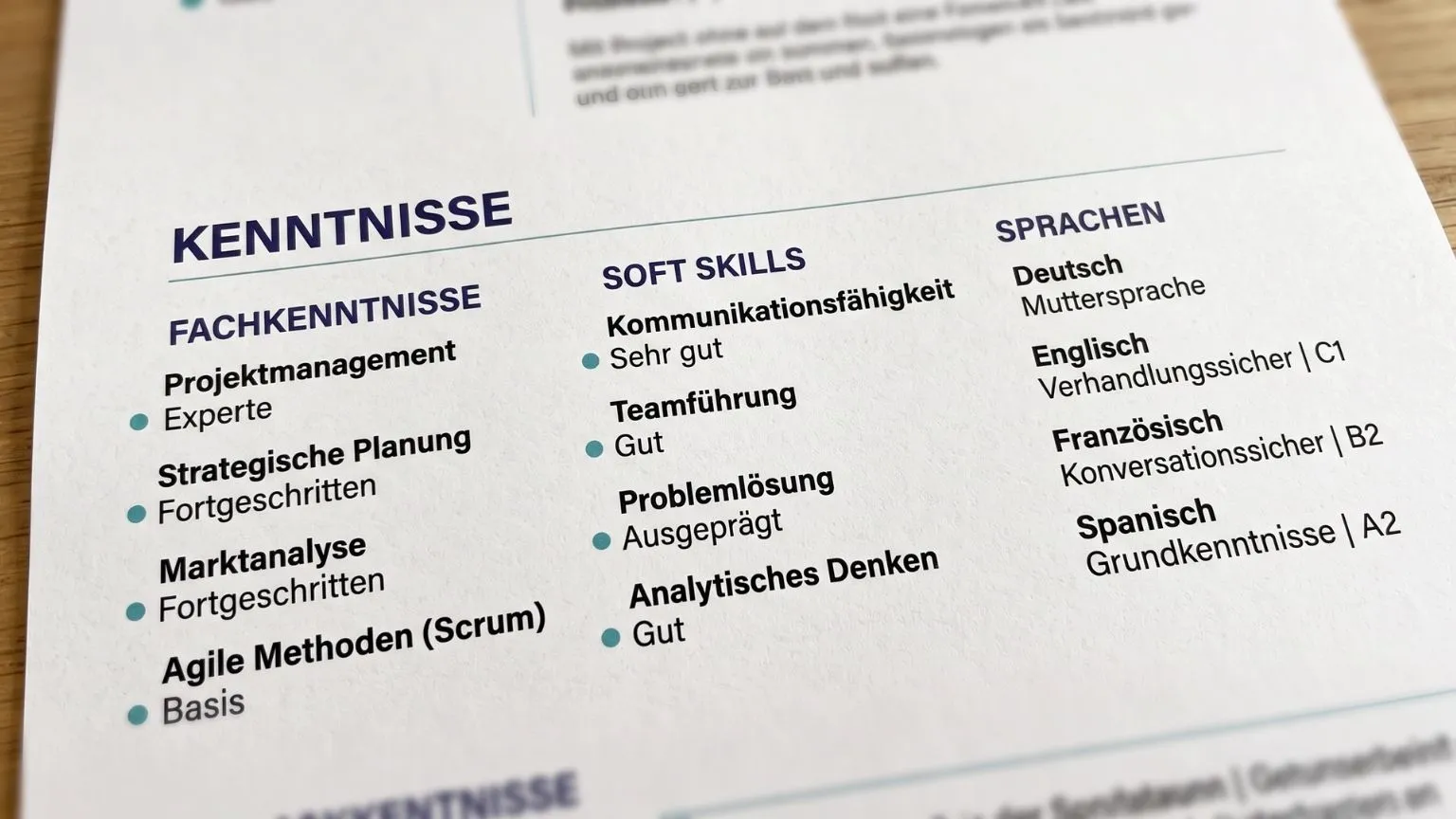
The skills block usually sits near the bottom and is the shortest part of the whole document. Those few lines still decide whether you turn up in a candidate search at all. Write "MS Office, English, team player" and you have done nothing wrong and won nothing either. Name the systems, the levels and the tasks instead, and a recruiter can match you against the requirements in seconds. This is the deep dive that goes with the complete CV guide.
Why this short block decides whether you get found
In many German companies your application lands in an applicant tracking system, and recruiters search it for words: "DATEV", "SAP MM", "Deutsch C1", "Staplerschein" (a forklift licence). Whatever is not spelled out as a word in your Lebenslauf (the German CV) does not exist for that search. How those systems read a document, and where they break, is the subject of the ATS-proof resume.
That leads to one simple rule you should apply twice. Every skill that matters belongs in the document in two places: once as a keyword in the skills block, and once inside the job entry where you actually used it. The block makes you findable, the entry makes you credible. And both times you use the wording from the ad. If the posting says Navision and you write "inventory management system", the search runs straight past you.
Hard skills and soft skills: where each one goes
Hard skills can be checked. A program, a method, a certificate, a language level, a driving licence: someone can ask you about it and judge the answer. Those are what the skills block is for.
Soft skills cannot be checked, at least not as a list. "Team player, resilient, strong communicator" appears on almost every CV and therefore says nothing about anyone. Qualities like these only land as a by-product of something you did. "Team player" becomes "trained new colleagues in accounts payable", "resilient" becomes "covered shift lead during peak season". Those sentences belong in your work experience or your Anschreiben (the cover letter), not in a row of adjectives.
How to state your level honestly
Skill bars, star ratings and percentage rings look tidy and have three problems: nobody knows what eighty percent Excel is supposed to mean, no parser can read a graphic, and a slider invites you to round up. Use named levels instead, and say what they mean in your hands:
- Basic: you find your way around and work with guidance.
- Advanced: you handle your daily work in it without help.
- Expert: you configure it, solve the odd cases and show others how.
The test is always the same: for every level you claim, you should be able to name a task in the interview that you completed at that level. Better still, skip the label and give the context. "Excel: pivot tables, VLOOKUP, monthly branch reporting" tells a reader exactly where you stand.
Software: name the system, not the category
"MS Office" is the most common placeholder on a German CV and close to empty. List the programs one by one, and where it makes a difference, name the module or the edition: "SAP S/4HANA, module MM", "DATEV Unternehmen online", "Microsoft 365 with Teams and SharePoint". With large systems the module is the real information, because SAP FI and SAP EWM are different worlds.
Sort by relevance to the role rather than alphabetically, and drop whatever has become basic equipment in your field. Email and web research only cost space, and space on a Lebenslauf is tight, as the piece on the right CV length works out. A line that the ad explicitly asks for, on the other hand, always earns its place.
Languages: the CEFR and the German buzzwords
There is a standard for languages, and you should use it. The Common European Framework of Reference for Languages, which German ads call the GER, has six levels from A1 to C2: A1 and A2 for basic users, B1 and B2 for independent users, C1 and C2 for proficient users. The level descriptions from the Council of Europe spell out what each one requires, and the Europass self-assessment grid walks you through it in a few minutes.
The terms German ads use alongside it are not levels. "Verhandlungssicher", which translates roughly as safe in negotiations, appears in no framework at all. It promises that you can discuss, disagree and settle a price or a date in that language. Recruiters read it as C1 and upwards, and they test it by switching languages without warning. "Fließend" sits somewhere around B2 to C1, and "gute Kenntnisse" means nothing measurable. So write the level and attach evidence: "German: B2 (telc B2, 2025)" or "German: B2, daily standups and customer calls in German". Certificates such as telc, the Goethe-Zertifikat, TOEFL or IELTS belong in the line with the year.
Your first language is the one exception. It is not a CEFR level, but "English: native speaker" is the accepted convention and everyone understands it. Adding C2 next to it reads as insecurity rather than precision.
Three fields, three sets of skills
No general list will tell you what counts in your field. Three examples show how concrete it gets.
Accounting and tax. Here the programs have names: DATEV Kanzlei-Rechnungswesen, DATEV Unternehmen online, Lexware, Addison. Next to them go the tasks you use them for: accounts receivable and payable, the Umsatzsteuervoranmeldung (the advance VAT return every German business files), fixed asset accounting, audit-proof document filing under the GoBD rules. A good line is not "accounting software" but "DATEV Kanzlei-Rechnungswesen: day-to-day bookkeeping and VAT returns for clients in trade and retail".
Logistics and dispatch. SAP with the module spelled out (MM, WM or EWM), Microsoft Dynamics NAV, still called Navision in daily use, or its successor Business Central, plus a transport management system. Alongside that: customs clearance through ATLAS, dangerous goods rules under ADR, a Staplerschein, route planning. "SAP MM: stock management and goods receipt postings for the central warehouse" beats any percentage.
Product and design work. Figma for interfaces and prototypes, Jira and Confluence for collaboration, Miro for workshops, an analytics tool such as GA4 for the numbers. On the method side: Scrum, user interviews, A/B testing. Context wins here too: "Figma: design system with reusable components for the ordering app".
The pattern behind all three is identical, whether you document care work in Vivendi or MediFox or run a public sector case management tool: name the system, add the task, attach evidence where you have it. If you are unsure which terms are standard in your field in Germany, the resume AI will draft the first version and align your wording with the words in the ad.
The three mistakes that cost the most
Buzzwords without evidence. "Hands-on mentality", "digital native", "excellent communication skills": these cost lines and give a recruiter nothing to ask about. Replace each one with something you did.
Rounding up. B1 becomes verhandlungssicher, two weeks of onboarding become advanced SAP skills. It falls apart in the first week on the job, often earlier in the interview. And it is not always without consequences: misleading an employer about a qualification the job explicitly required can give them grounds to challenge the contract under section 123 of the German Civil Code (status August 2026). How a court would judge any single case is another matter, and this article is not legal advice.
The basic-knowledge graveyard. Fourteen tools, every one of them marked "basic", do not read as breadth. They read as filler, and they dilute the three lines that actually matter. Anything that is neither in the ad nor at a real level can go.
One last test for every line you keep: which task did I complete with this, and could I describe it in two sentences without stalling? Whatever survives that question stays. The rest makes room for what really separates you from the other applications in the same pile.
Frequently asked questions
How many skills belong on a CV?
As many as you can defend in an interview, and few enough that the important ones sit at the top. Eight to twelve lines, split into professional skills, software and languages, work for most people. Anything that is missing from the job ad and does not set you apart can go.
What does "verhandlungssicher" mean in a German job ad?
No framework defines it. In practice it describes someone who holds their own in that language under pressure: in a dispute, on the phone, in a negotiation. Because the expectation behind the word is high, only put it on your own CV if you could produce a C-level certificate to back it up.
Should I write my CV skills in German or English?
Use the words the employer will search for. System names, modules and German process terms stay in German even in an English CV, because nobody filters for "advance VAT return" when the internal word is Umsatzsteuervoranmeldung. The surrounding sentence can be English.
Does a driving licence belong in the skills section?
Only if the job involves driving, for example in field sales, care work, the trades or logistics. In that case name the class, and mention your own car if it matters. For a desk job the line is wasted space.