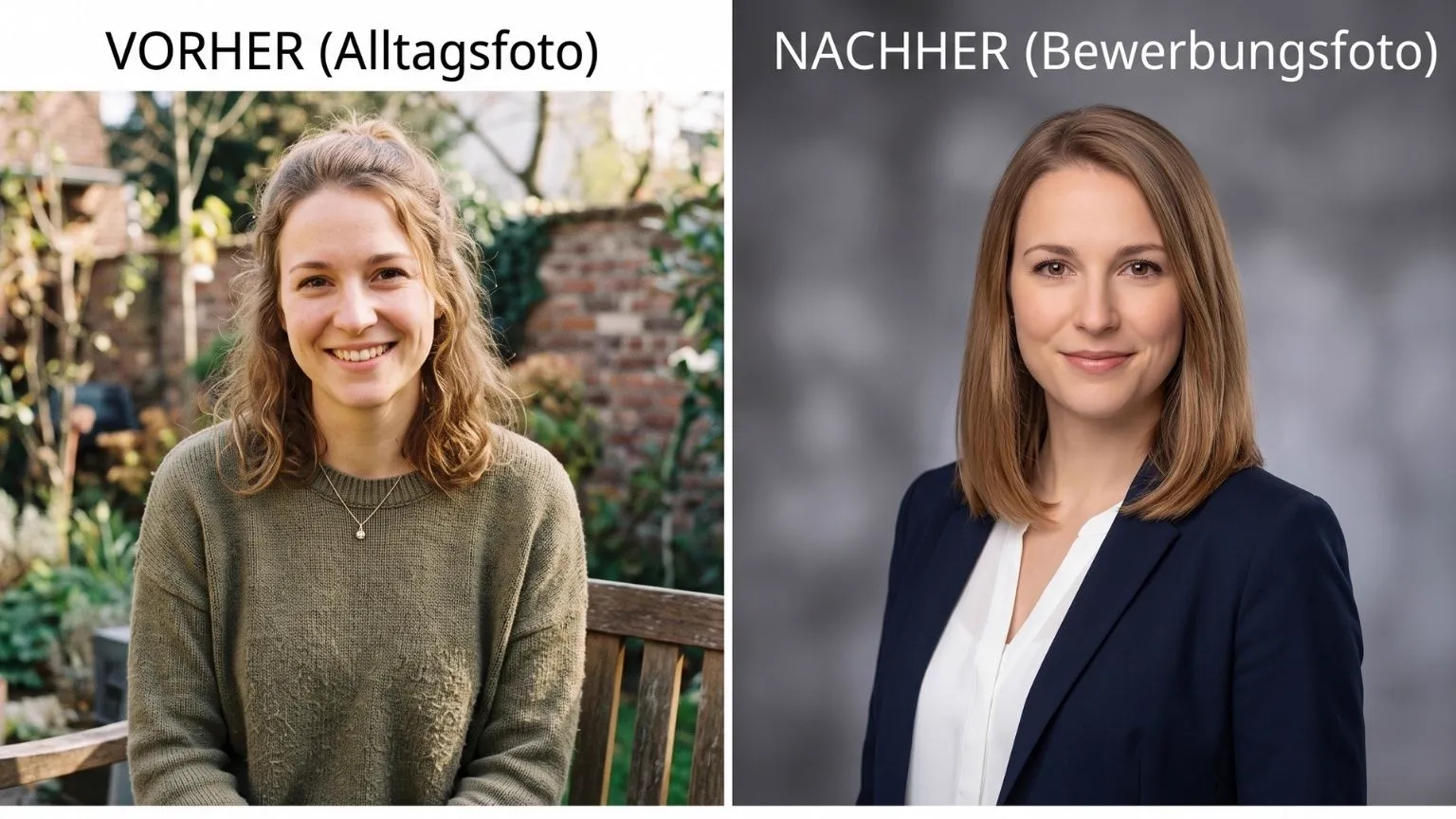
Generated application photos went from novelty to normal option in a short time: you upload a few selfies and get studio-style portraits back, with no appointment, no photographer and a fraction of the cost.
Whether that is a good idea comes down to a single question, and it is rarely asked. It is not "will anyone notice" but "does the person in that picture look like me when I walk through the door". The framing for AI use generally is in the guide to using AI for your application.
Why this is suddenly everywhere
Three things came together. Image quality got good enough that results look professional at first glance. The services are low-threshold: phone, a few pictures, done. And a photo session is a hurdle for many people, on cost, on time, or simply because it feels uncomfortable.
There is also a German specific: a photo in the CV is not required here, but it is still common. Leaving it out is a deliberate decision; including one means you need a usable picture. What speaks for and against the photo at all is in the article on CV photos in Germany.
The honest trade-off
In favour: a decent portrait beats a cropped holiday snap, and that snap is the realistic alternative for most people. Anyone who struggles with photo sessions gets a usable image at all this way.
Against: generated images smooth. They even out skin, make features more symmetrical, sharpen the gaze. The sum is a person who resembles you but looks slightly different from you.
And that is where the only criterion that really counts hangs: the photo has to look like you in the interview. Not like your best version, like you. If someone collects you from reception and hesitates for a second, the picture hurt rather than helped, without anybody having thought about AI at all.
The test is simple: show the result to someone who knows you and ask whether it is you. Not whether it looks good.
How to spot a bad result
Six places where generated images fail, all worth checking at full size.
- Hands. If one is in frame: count the fingers. Still the most reliable weak point.
- Ears and jewellery. Earrings existing on one side only, ear geometry that cannot be built.
- Glasses. Arms that end in nothing, mismatched lens thickness, reflections that do not match the light.
- Hairline and beard. Transitions that are too soft, individual strands growing out of the head rather than on it.
- Collars and patterns. Checks and stripes drift apart at the seams. Hence plain clothing in the source photos.
- Background. Bleeding edges, an office that cannot exist architecturally, light sources without shadows.
Then there is an impression that is harder to name: plastic skin. Too even, too matte, no pores. People recognise it even when they cannot articulate it, and it reads worse than any visible wrinkle.
Rules for a usable result
Your own photos as the basis, plenty of them. Different angles, different days, natural light. The more real material, the less the model invents.
Stay understated. A neutral background, normal clothing, no staged skyline view. The more elaborate the staging, the sooner it falls apart.
Do not make yourself younger or slimmer. Every change to your face widens the gap to the interview. What you may correct: light, crop, background, a crooked collar.
Plan for several rounds. The first attempt rarely produces anything usable. Expect that and you will not be disappointed.
Inspect at full size at the end. Not as a thumbnail. Flaws only appear when the image is large.
The legal side
Two points cover practice.
Only your own face. The right to one's own image protects every person depicted; the basis is section 22 KunstUrhG. Other people's faces, including as input material, are off limits, and so are images with other people in the background.
Check the provider's terms. Two questions decide: are your uploaded images used for training, and how long are they stored? A face is a biometric feature and therefore particularly sensitive data. If a provider gives no clear answer to that, the absence is the answer.
What is not an issue: whether you have to disclose the editing. No such duty exists for application photos.
One more point that gets confused: an employer may not require a photo, because the German equal treatment act stands against it. They may expect one, and in practice many do. That gap between the law and the custom is the actual reason the photo question gets relitigated every year.
Photographer, AI, or no photo
Photographer. Still the best result, because a human directs light, posture and expression. Costs money and an appointment, and lasts for years.
AI. Cheap, fast, repeatable, with the smoothing risk. For a solid standard portrait it is usable now, provided you follow the rules above.
No photo. Entirely acceptable, in some processes even preferred, and in public sector procedures often irrelevant. A missing photo beats a bad one, and a CV without an image only looks empty when the template was not built for it.
Which is why the CV templates come in both variants: with a photo slot and in a deliberately plain version without. How the photo is produced and how to judge the result is on the application photo page.
Frequently asked questions
Can recruiters spot AI photos?
Bad ones yes, good ones often not. The giveaways are hands, ears, glasses, hairlines and backgrounds that dissolve on close inspection. More important than detection is whether it looks like you.
Is an AI photo dishonest?
No, as long as it shows you. An edited portrait is no more deceptive than a retouched studio shot. It becomes a problem when the image shows a person you visibly are not in the interview.
What does a good AI photo cost?
Considerably less than a photo session, and provider prices vary widely. Expect several rounds before a usable image appears, and factor that effort into the comparison.
What should I wear in the source photos?
What you would wear to the interview, in plain fabrics without patterns. Patterns and logos reliably confuse generated images, and the collar is where it shows first.