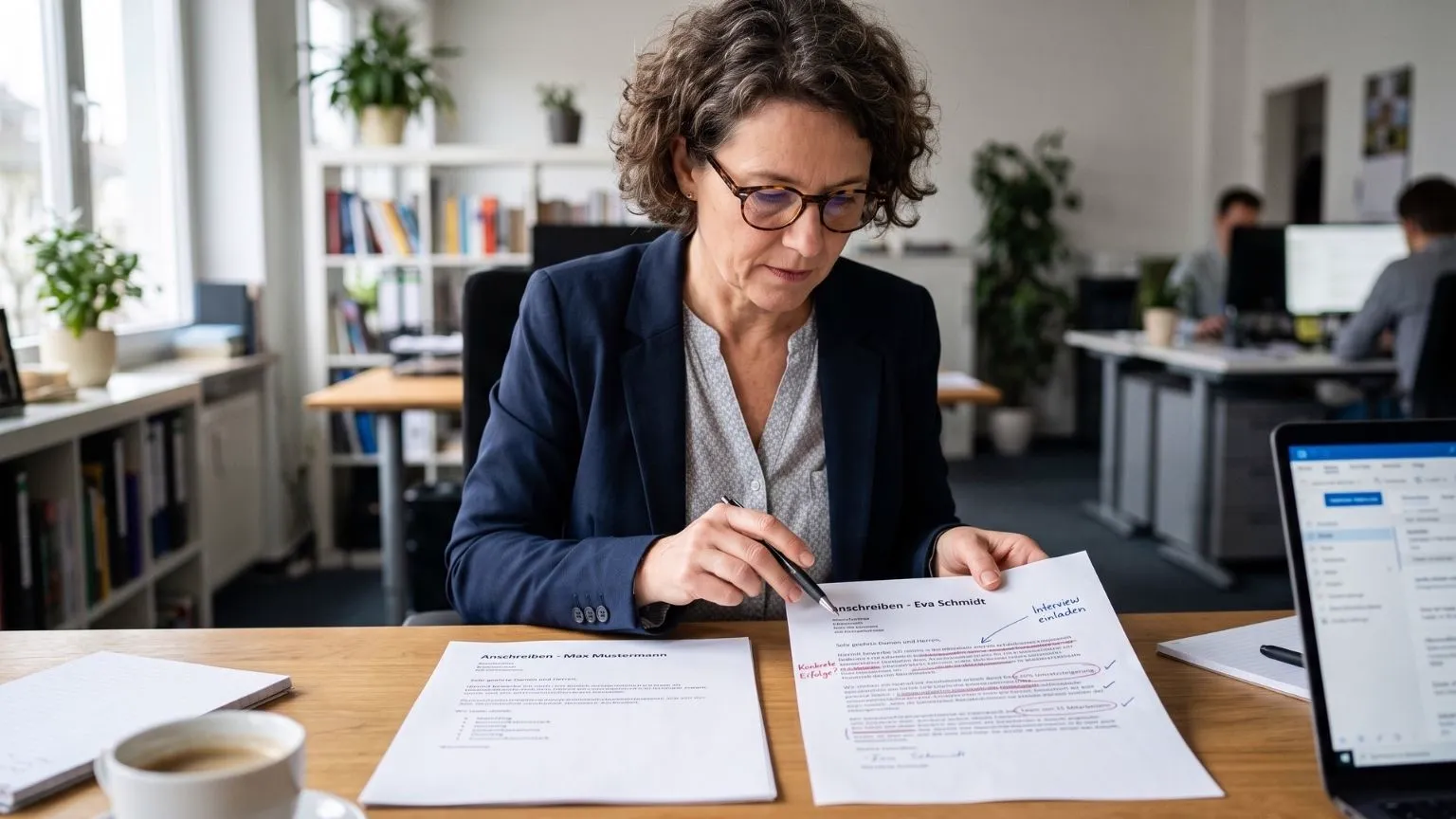
The worry is common and slightly misdirected. Yes, generic texts get spotted. No, not because somebody runs software over them, but because a person reading twenty cover letters a day develops a very good sense for sentences that could fit anywhere.
This article covers where that comes from, why detectors should not matter, and how to turn a draft into yours. The framing is in the guide to using AI for your application.
Yes, often, but not the way you think
Detection happens through content, not technology. What stands out is not "written by a machine" but "could be from anyone".
The distinction matters because it determines the fix. Against software you would have to game something. Against the impression, only one thing helps: getting concrete. And that is the better application anyway.
The five patterns recruiters notice
They repeat so reliably you can almost predict them while reading.
Perfect blandness. The text is flawless, well built, pleasant to read and says nothing. No name, no number, no system, no place. After two paragraphs you know no more about the person than before.
The same rhythm throughout. Medium-length sentences, evenly distributed, with the same transitions. Humans write more unevenly: sometimes three words, sometimes four lines.
Adjective chains. "Committed, reliable and solution-oriented." Three qualities in a row is a very reliable sign that an example is missing here.
Uniform enthusiasm. Everything is exciting, challenging and inspiring, in the same tone, across the whole page. Real enthusiasm is local and has an object.
Company references from the kit. "Your innovative company with its impressive market position" fits any firm with more than ten employees and is therefore not a reference at all.
What stands out about this: none of these patterns is new. The same sentences appeared in bad cover letters ten years ago, just less often. AI did not invent the problem, it scaled it.
AI detectors: why they should not matter
Programs exist that claim to identify generated text. They work statistically: how predictable is the next word, how uniform are sentence structure and word choice. From that they compute a probability.
The method has three weaknesses that make it useless for hiring decisions.
False positives. Plain, clear, uniform language looks statistically like machine language. Texts by non-native speakers who deliberately write simply and correctly are hit particularly hard, as are texts from formalised fields like administration or engineering.
No evidential value. A probability score is not proof. A company sorting somebody out on that basis alone is making a decision it cannot justify.
Easily circumvented. A thorough rewrite already changes the statistical markers. So the detector catches exactly the wrong people: the careful ones who wrote it themselves, not the careless ones who copied.
In practice: do not write for a detector. Write for a human.
What actually gives it away: the interview
The most reliable detection does not happen while reading. It happens in the interview, and it is involuntary.
One standard question is enough: "You write that you supported the migration. Tell me what your part in it actually was." Someone who meant the sentence talks for two minutes. Someone who copied it runs out after twenty seconds.
That gap cannot be closed with preparation if the content is not true. It is very easy to close if it is: then you simply describe what happened. The job check helps here: it shows which sentences in your documents will draw a follow-up.
Where the line runs between phrasing help and a false statement is covered in the article on whether AI is allowed in applications.
How to keep the text yours
Three moves, ten minutes in total.
Add three pieces of evidence. In each paragraph, replace one general statement with something checkable: a quantity, a duration, a system, a place. Not "extensive experience in customer contact" but "around 40 cases a day, a third of them complaints".
Write one sentence only you could write. An observation from your working day, a concrete link to the company, a decision you made. A single sentence like that changes the impression of the whole page.
Break the rhythm. Merge two sentences, split a long one. Unevenness is a quality marker, not a defect.
What not to overdo
There is a counter-movement as misguided as the fear of detectors: deliberately adding mistakes so the text seems "more human". Typos, clumsy sentences, a knowingly awkward construction.
That is a bad trade. A recruiter who finds a typo does not think "ah, genuine", they think "careless". Being error-free was never suspicious; it is the normal state of a good application, handwritten ones included.
What is suspicious is emptiness, and you do not repair that with mistakes but with substance. If you are unsure, have a second person read it who does not work in your field. If they can say afterwards what you do and what you are good at, the text is fine.
The self-test before sending
Four questions, answered honestly:
- The swap test: replace the company name and job title. If the text still works, the reference is missing.
- The number test: does every paragraph contain at least one checkable detail?
- The explain test: can you talk freely for two minutes about every sentence?
- The read-aloud test: does it sound like you?
If the answers hold, the detection question is settled. Not because you hid anything, but because there is nothing to detect: the text is yours, whatever tool built the first draft.
Frequently asked questions
Do companies reject AI-written applications?
Some state explicitly that they expect a self-written letter. Most sort by content rather than by tool. What gets filtered out is an interchangeable text, not an AI-assisted one.
Are AI detectors reliable?
No. They guess from statistical language patterns and produce false positives regularly, particularly with texts by non-native speakers and with very plain prose. As evidence they are worthless.
How do I personalise an AI draft?
By replacing every general statement with something checkable: a number, a system name, a place, a situation. Three such spots are enough to make a text unmistakable.
Does an ATS detect AI text?
No, it is not built for that. An applicant tracking system breaks documents into data fields and makes them searchable. It assesses structure and keywords, not authorship.