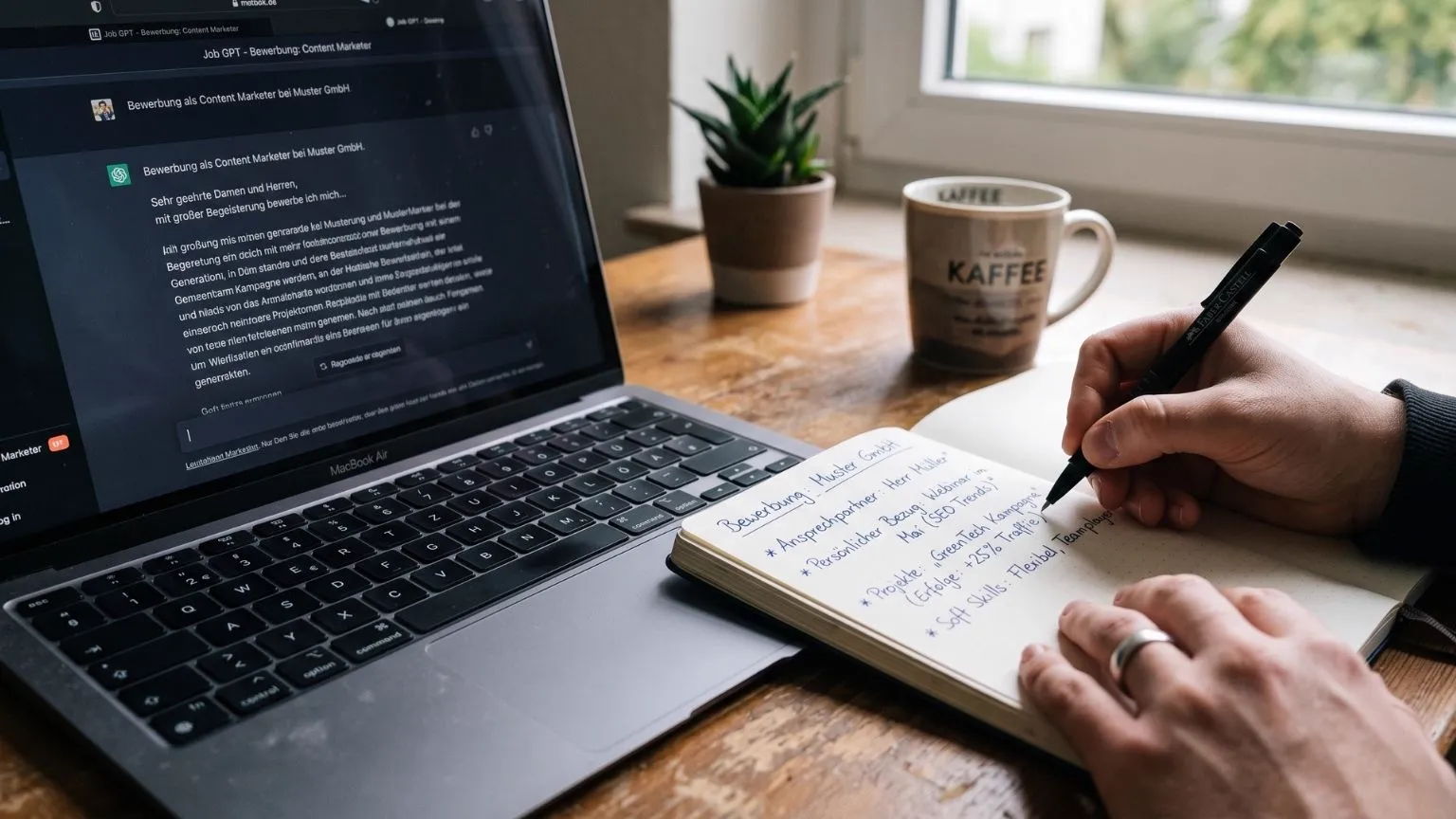
For most people ChatGPT is the first contact with AI in job hunting, and for many it stays the only one. That is understandable: free, instantly there, no commitment. It is also why HR teams now read dozens of cover letters with the same build and the same tone.
This article shows how to do better than the average, and says honestly where a general-purpose chat is structurally not enough for this task. The framing is in the guide to using AI for your application.
What it does well and where it embarrasses you
Well: proposing structure, rewriting paragraphs, turning passive into active, cutting, translating, shifting tone, answering questions you would rather not ask a person. For anything that concerns language and invents no facts, the tool is excellent.
Embarrassing: it invents. Not out of malice, but because it produces plausible sentences rather than true ones. In a cover letter that reads well; in an interview it does not. Typical cases: a percentage nobody measured, a project assembled from two others, a title that sounds like a promotion.
Then there are the conventions. A model trained mostly on English-language material suggests things that are unusual in a German application: an objective statement at the top of the CV, referees with phone numbers, a narrative tone that reads as affected here. None of it is a mistake in the narrow sense, which is exactly why proofreading does not catch it.
The prompt decides
Most prompts amount to "write me a cover letter for this job". The result is a text about the job, not about you.
A usable prompt contains four things: the ad, your material, the target role and the tone. Three examples to copy and adapt.
1. Analyse first, do not write yet:
Here is a job advertisement. List the five requirements that matter most to this employer, ordered by weight. Justify each in one sentence with a passage from the text. Do not write a cover letter yet.
[paste the ad]
2. The draft, with your material:
Write the core of a German cover letter, two paragraphs, maximum 150 words. Use only the details below and invent nothing. Phrase every statement as a result, not as a task. No conditional, no adjective chains, no superlatives.
My stations: [bullet points with numbers] Requirements from the ad: [from step 1]
3. The critique round:
Review this draft critically. Mark every sentence that would fit any application, and every claim I could not support. Do not rewrite anything, just list them.
[paste the draft]
Step 3 is the one almost nobody runs, and it has the most effect. Models are agreeable by default: ask whether the text is good and they say yes. Ask for weaknesses and you get a usable list.
The cover letter workflow
Three passes, about twenty minutes in total.
Pass 1: analysis. Ad in, requirements out. You then decide which three you can serve.
Pass 2: draft. Your material in, core out. Not the whole page at once but paragraph by paragraph. Smaller tasks produce more concrete results.
Pass 3: personalisation. Now without AI. Replace every general statement with something checkable, write the first sentence yourself, and read the whole thing aloud. What makes generic texts stand out is in the article on whether employers can detect AI.
What you do after every pass: check the facts. Numbers, date ranges, titles, system names. Two minutes, and the only step where a mistake gets genuinely expensive.
The CV: what the chat should not see
With the CV the temptation is to paste in the whole document. That is where caution belongs, because a CV is one of the densest collections of personal data you own.
Leave out:
- Address, date and place of birth and anything else identifying
- Names of third parties from references: managers, colleagues, clients
- Health, religion, origin, which sometimes appear in German references or letters
- Internal project names and anything covered by a confidentiality agreement
For phrasing work the model needs none of that. It needs your activities, numbers and date ranges. Anonymising takes under a minute: placeholders instead of names, drop the header block, put the rest in.
The limits
Three things a general chat structurally cannot do, and no better prompt changes that.
It does not know the employer. What is happening at that company right now is not in its knowledge, and if it invents something it sounds plausible and is wrong. Company research stays yours.
It checks nothing. There is no fact check, no comparison against your CV, no warning when one claim contradicts another.
It remembers nothing. Next letter, you start from zero, pasting the same details again. Anyone applying every few days notices quickly.
There is also the output format: what comes out is text in a chat window. Layout, a letterhead following the German DIN standard, and a text PDF an applicant tracking system can read are a separate job again.
When a specialised tool is the better choice
Honestly: not always. If you apply twice a year, a free chat plus twenty minutes of manual work is entirely sufficient, and nobody should sell you a subscription for that.
Three things tip the balance. First, applying often and retyping the same details each time. Second, needing finished documents rather than text: layout, cover page, text PDF. Third, losing track of who received what and when.
Those three are where Jobvin comes in. The AI cover letter works from your stored profile plus the ad and knows German application standards by default; the one-click application turns that into finished documents. What it cannot do: tell you whether the job suits you, and take responsibility for the text. That stays with you in either world.
Frequently asked questions
Is ChatGPT free for job applications?
There is a free tier that is enough for drafts, and paid tiers with stronger models and higher limits. For a cover letter the free version is usually sufficient.
What does the prompt need to contain?
Four things: the job ad, your relevant stations with numbers, the target role and the tone you want. Leave one out and the model fills the gap with generalities.
Can I paste in the job advertisement?
Yes. A publicly advertised role is not a secret. Be careful with internal documents and with ads containing personal details of named contacts.
Why do ChatGPT cover letters all sound the same?
Because they come from the same average and because most people give the same terse prompt. The less of your own material goes in, the more the average takes over.