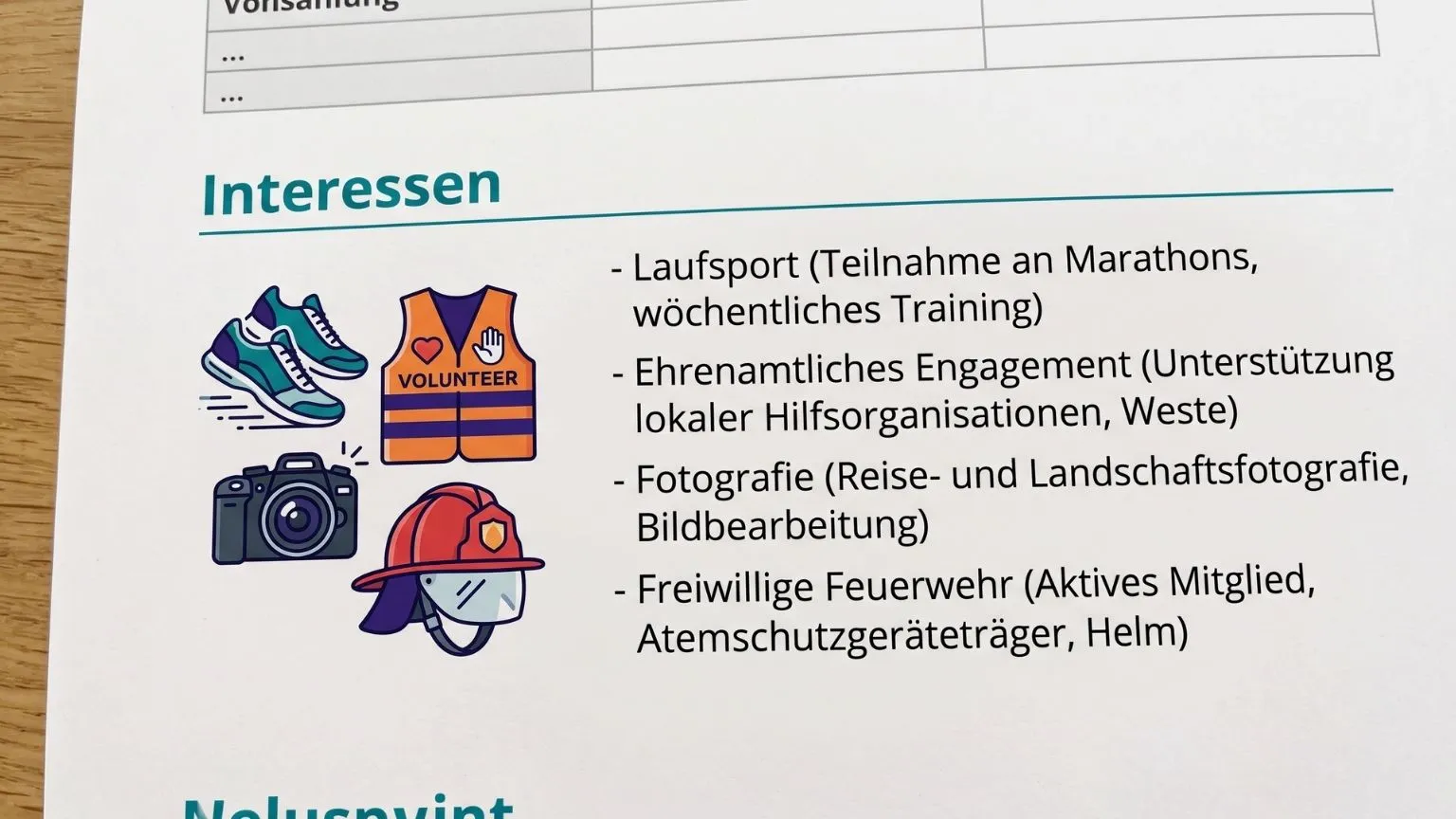
The last line of a German CV is the only one nobody asked you for. That is exactly why it gets read as a statement about you: what does someone write when they have a free choice? Put "reading, travelling, music" there and you have spent three words on nothing. Put "Freiwillige Feuerwehr, active duty since 2018" there and you have chosen the first question of your interview yourself.
This piece covers when an interest proves something, how to phrase it so that it does, and when to delete the section altogether. For the document as a whole, see the complete CV guide.
Why anyone cares about your hobbies
If you have applied in the UK or the US, you may have watched this section disappear from resumes over the past decade. In Germany it survived. Your Lebenslauf (the German CV) still tends to end with a short block headed Interessen, and in care work, education, the public sector and anything with an apprenticeship attached, recruiters still read it.
It sits at the bottom and gets read last, often only once the rest has already convinced someone. Even so it does two jobs no other section can do.
First, it is the opening question. Plenty of German interviews start with a warm-up, and that warm-up tends to come from this line, because it is the only personal thing in the document. What you write there shapes the first five minutes of the conversation. So write nothing you cannot happily talk about for two minutes.
Second, in some jobs it is evidence rather than decoration. Someone who coaches a children's team in a Verein (a registered local club) has group experience that no certificate records. Someone who has been on active duty with the Freiwillige Feuerwehr (the volunteer fire brigade) knows night call-outs from the inside. In nursing, childcare, emergency services and sales, hiring managers factor that in. For international applicants there is a third effect: being part of something local answers, without you saying it, the quiet question of whether you intend to stay.
What the section cannot do is compensate for a missing qualification. No amount of volunteering replaces the degree the ad asks for.
Hobbies that prove something
An interest becomes evidence when three things stand next to it: how long you have been doing it, what role you hold, and something a stranger could check. Drop one of the three and you are back to a claim. Six examples, each with the line as it would actually appear on the page:
- Team sport. Shows commitment across years and a willingness to take a
role. The entry is not "sport", it is:
Volleyball, Bezirksliga TV Hofheim, team captain since 2019 - Volunteering with a fixed duty. Proves you keep appointments nobody pays
you for:
Reading mentor, Grundschule Nord, one hour per week since 2022 - Volunteer fire brigade or ambulance service. The strongest entry for
shift work, because disruption is the normal state:
Freiwillige Feuerwehr Bad Vilbel, active duty since 2018, Truppführer (squad leader) - Endurance sport with a goal. Shows months of preparation rather than one
enthusiastic weekend:
Marathon, three finishes since 2022 (Frankfurt, Cologne, Hamburg) - Club committee or treasurer. Real responsibility, usually with a number
attached:
Treasurer, Kleingartenverein Süd, annual budget around 12,000 euros, since 2021 - Tinkering close to your field. Extends your skills into your own time
without listing them twice:
Open source: scheduling plugin for a club portal, around 40 commits since 2024
Look at what those six lines have in common. Every one carries a place, a number or a role, and not one of them claims a personal quality. Nowhere does it say "team player" or "resilient". You leave the conclusion to the reader, which is precisely why she believes it. If you are unsure which strength your own activity actually demonstrates, the strengths tool does the translating: it works through what you do and suggests wording you can reuse in a cover letter.
Hobbies that can work against you
Four groups are delicate, for four very different reasons.
High-risk sport. Skydiving, free climbing, motocross. None of it is a flaw, but in some HR departments it raises a quiet question about sick days, particularly for physical work. That is not a reason to hide anything. It is a reason to know the question exists and to have a calm answer ready.
Clichés with no content. "Reading, travelling, music" does no direct damage, it just costs space and says exactly as much about you as it does about everyone else. If you cannot add a second half that makes a keyword concrete, that is the signal: the keyword carries nothing.
Politics, religion, union work. This cuts both ways. These are protected characteristics: the Allgemeines Gleichbehandlungsgesetz, Germany's General Equal Treatment Act, names religion and belief explicitly, and political opinions, religious convictions and trade union membership count among the specially protected categories of personal data. As a rule, an employer is not allowed to ask.
None of that amounts to advice to hide. It only means the decision is yours, and that it depends on the employer. At a church-run organisation, a welfare association, a union or a party-linked foundation, that involvement is the very thing that qualifies you, and leaving it out would be the mistake. At an ordinary mid-sized company it has nothing to do with the job, so it is information you may give and do not have to. You decide what appears in your documents. This is context for that decision, not legal advice (as of August 2026).
Anything that reads like a second job. Club chair plus local politics plus two coaching licences: two such lines are an asset, five turn into a question about your availability. Pick what fits the role and leave the rest out.
Phrasing: specific beats a list
The rule fits on one line itself: the activity, the role or level, the period. All three in a single line, with no explanatory sentence trailing behind. The difference looks like this:
- "Sport" becomes
Volleyball, Bezirksliga, team captain since 2019 - "Volunteering" becomes
Youth coach, TSV Kirchheim, two sessions per week since 2021 - "Music" becomes
Trombone, Musikverein Rheinbach, weekly rehearsal since 2015 - "Travel" becomes
Cycle touring, most recently the Danube route, 900 kilometres in twelve days - "Reading" becomes
Non-fiction reading circle, city library, monthly since 2023, or it goes
Head the section Interessen if your Lebenslauf is in German, Interests if it is in English. Both are conventional and both are recognised by applicant tracking systems. Creative headings such as "What drives me" throw the parser off and make a human pause. If your volunteering needs more than one line, give it its own block titled Ehrenamtliches Engagement (voluntary commitment) and put it above the interests, closer to your skills section than to your free time.
The place for all of it is the very bottom, after skills and languages, one line per entry rather than a paragraph. The CV templates already position the block there, so you either fill it or switch it off without the layout collapsing.
When to leave it out
There are four good reasons to drop the section, and modesty is not one of them.
You are out of space. A CV that fits on two pages is more likely to be read in full. If something has to go, the interests line goes before an entry with numbers in it. What else you can cut when it gets tight is covered in CV length.
Nothing meets the three criteria. If you honestly have nothing where duration, role and verifiability come together, leave it out. A missing section goes unnoticed. A filler line does not.
You have fifteen years of experience. By then your career carries the document on its own and the 2019 marathon is just in the way. This section is mainly a tool for people early in their working life, for career changers, and for anyone whose CV still has room.
The portal has no field for it. If you are typing into an online form that asks only for roles, qualifications and skills, do not invent a slot. A single sentence in the cover letter does the job when your volunteering genuinely fits the role.
The reverse case matters just as much. If you are early in your career, moving in from another field, or explaining a gap, this is one of the few places on a German CV where you get to add something of your own choosing. That makes it worth the quarter of an hour it takes to turn "sport" into a line somebody wants to ask about.
Frequently asked questions
Do I have to list hobbies on a German CV?
No. There is no rule and no expectation you could disappoint. Nobody notices a Lebenslauf without an interests section. They do notice one filled with nothing.
How many hobbies should I list?
Two to four entries, one line each. A longer list reads like padding and dilutes the single entry that actually says something about you.
Does it help to show that I am involved locally in Germany?
Often yes, more than international applicants expect. Membership in a Verein (a registered club), a sports team or a volunteer group reads as commitment and as roots in the area, which matters to employers who worry that a foreign hire will leave again within a year.
Can a hobby cost me the job?
Rarely on its own, but this is the one section you fill in voluntarily, so it gets read as a sample of your judgement. The risky entries are the ones that carry an opinion while having nothing to do with the role.