The last paragraph of a cover letter is the one where the air goes out. The opening got rewritten three times, the evidence is in place, and then the text ends with a sentence somebody wrote once and everybody has been copying since: "Über eine Einladung zu einem persönlichen Gespräch würde ich mich sehr freuen."
The sentence is not wrong. It is simply the only place in the letter where you put yourself into the subjunctive, and with it you hand back a piece of what the page has just built. For how the rest of that page is built, see the complete cover letter guide.
The last impression is the one that stays
While reading, the beginning sticks. After putting the page down, the ending does. The final paragraph is where an application turns into an impression of a person: composed or pleading, decided or non-committal.
It also has a practical job. This is where the organisational facts live that an HR department needs in order to plan with you at all: when you can start, and, if the ad asked, what you want to earn. A closing made of politeness alone forces a follow-up question, and follow-up questions cost days.
Confident instead of conditional
The difference comes down to one grammatical move.
"I would be delighted" becomes "I am glad to". "I could imagine" becomes "I bring". "I would like to show you" becomes "I will gladly show you". The conditional describes a possibility, the indicative a fact, and your gladness about an invitation is not a possibility.
A second rule follows: the closing talks about the next step, not about a wish. "I would be delighted about an invitation" turns the invitation into a favour. "I would be glad to walk you through how I approached that migration" turns the meeting into the next work step. Same content, different role.
What you do not have to do is get loud. Confident does not mean "I am convinced I am the ideal candidate for this role". Sentences like that claim the result of a selection that has not happened yet, and they read as insecure rather than composed.
Ten closings that work
Standard application to a posting:
I would be glad to walk you through how I supported the rollout of the new system.
I look forward to your reply and to talking about the role.
I would be happy to meet, at short notice if that suits you.
When a notice period is running:
My current contract has a three month notice period to the end of a quarter, so I am available from 1 January. I look forward to hearing from you.
When the ad asked for your salary expectation:
My salary expectation is 54,000 euros gross per year. I look forward to a conversation in which we go through the role and its scope in more detail.
Speculative application:
I do not know whether or when a position opens up with you. If you have a need, I would be glad to come in for a conversation.
After a trade fair or a phone call:
Following our conversation at the trade fair in Hanover, I look forward to going through the topics in more depth with you.
Internal application:
I would be glad to discuss how I hand over my current tasks and when I could start in the new role.
Application involving relocation:
My move to Leipzig is planned for March, and I will cover the travel costs for an interview myself.
Apprenticeship:
I look forward to meeting you and showing you why I want to learn this trade.
What does not belong in the closing
Four things break the last paragraph, and three of them are well meant.
The ultimatum. "If I do not hear from you by the 30th, I will assume there is no interest." That is not confidence, it is a threat without leverage.
The submission. "I hope you consider me suitable" or "Thank you in advance for your effort" place you below the reader. Applying is an offer, not a request for a favour.
The ritual thanks. "Thank you for your time and attention" reads like the end of a slide deck and says nothing.
The recap. A closing paragraph that summarises the arguments from the core lengthens the page without gain. Nobody who has just read the arguments reads the summary.
Fitting in salary and availability
Both belong in their own short sentence before the offer to meet, not in the middle of it. The order is availability, then salary, then the meeting. That way the paragraph ends on the offer rather than on a number.
For salary, give an annual gross figure without hedging words like "negotiable". A range is fine if it is narrow. German salaries are quoted as annual gross totals, so unless you say otherwise, that figure is understood as the whole package.
For availability, be concrete. "Immediately" only if it is true. If a notice period applies, name it and the resulting date. That saves the HR team an arithmetic step and quietly shows that you know your own contract.
If the closing grows too long, the core is usually the culprit. For a cutting procedure that keeps your evidence, see the article on cover letter length.
Sign-off and signature
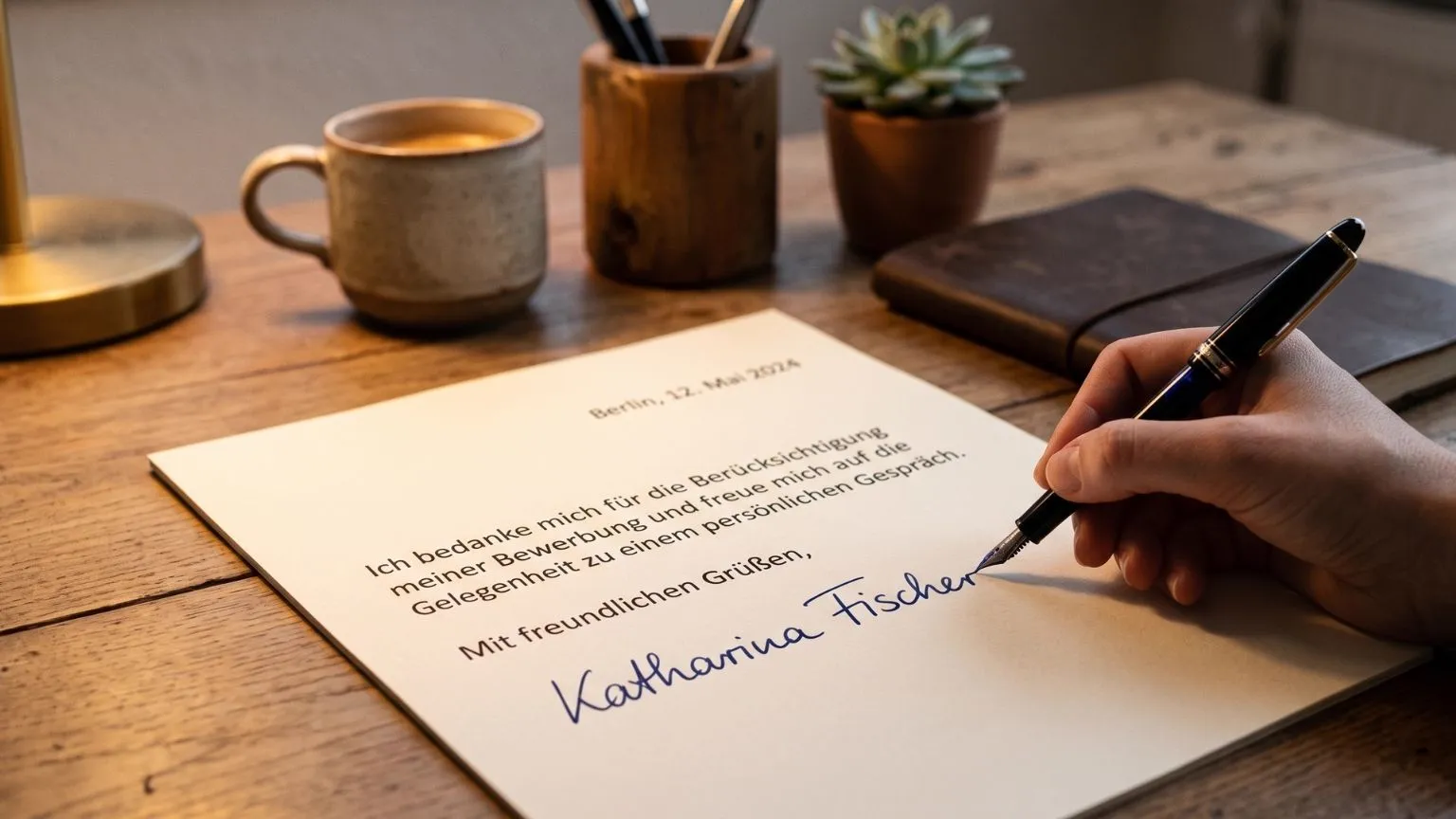
"Mit freundlichen Grüßen" is standard and never wrong. No comma follows it in German, just a blank line and then your name. In a PDF, a scanned or digitally drawn signature belongs between the sign-off and your typed name. In online forms it is not needed.
Small things that get noticed anyway: the sign-off does not sit alone on a second page, it stays with the last paragraph. The name below it is your full name, not just your first name. And a line listing enclosures underneath is out of use in digital applications, where the file list does the same job.
Frequently asked questions
Is "I look forward to your reply" too forward?
No. In Germany that line is completely standard and is not read as pushy. It only turns forward if you set a deadline of your own ("I will call you on Tuesday") without any reason to.
Does the salary expectation belong in the closing?
Only if the ad asked, and then yes, in the second to last sentence. Volunteering it early narrows you. Being asked and not answering reads as evasive.
Which sign-off is correct?
"Mit freundlichen Grüßen" is the standard and never wrong. "Freundliche Grüße" is slightly more modern, "Beste Grüße" is too casual for an application. No comma follows the German sign-off.
Should I actively propose a meeting?
Yes, in one sentence and without conditions. "I would be glad to walk you through how I work" is an offer. Proposing a specific date belongs only in a speculative application following an earlier contact.