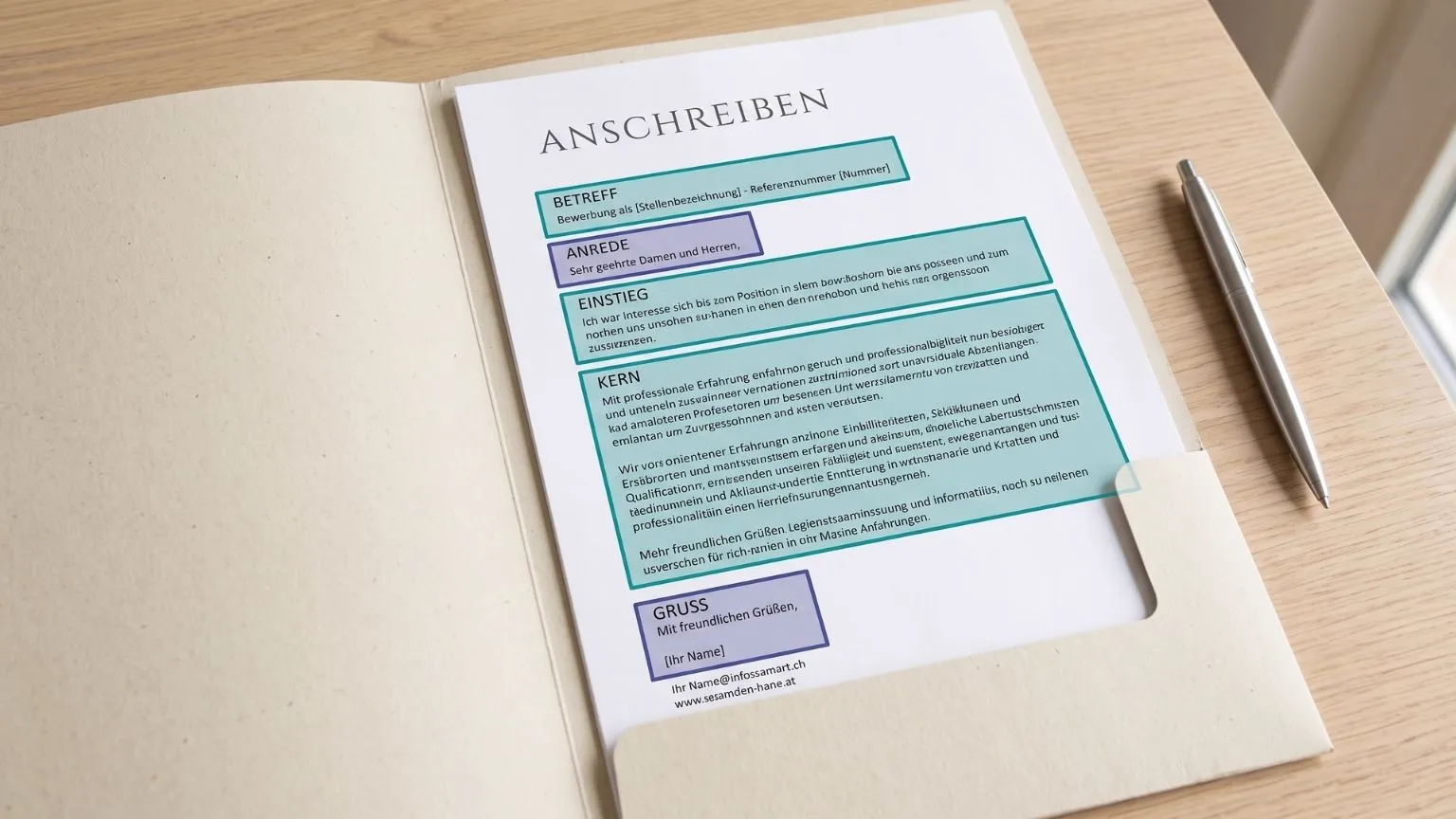
Your CV says what you have done. The cover letter says why you, specifically, fit this one job. In Germany that document has a name, Anschreiben, and a set of conventions that are older and stricter than most newcomers expect. It is also the part of the application where people get stuck: a CV can be worked through, a cover letter demands a decision about which parts of you matter to this employer.
The reassuring part is that the decision is a craft, not an inspiration. A German cover letter has five building blocks, each with one job, and once every block does its job the text is finished. This guide walks through them in order: structure, opening, evidence, company reference, form, and the mistakes that keep repeating. If you are still building the document that goes with it, start with the German CV guide.
What the Anschreiben is still for
Cover letters have been declared dead for years, and at some employers they genuinely are. Portals that ask only for a CV and contact details are normal now. Still, a large share of German job ads asks for a Motivationsschreiben, and the reason is not nostalgia.
Your CV answers three questions: what can you do, where did you do it, for how long. What it does not answer: why are you moving now. Why this industry after ten years in another one. Why are you applying for a role that sits below your last job title. Those are exactly the questions that make a German HR department pause, and the cover letter is the only place in the file where you can answer them before someone invents an answer for you.
The second purpose is less comfortable: the letter is a work sample. Writing clearly, in order, without filler, is a skill used daily in almost every office job in Germany, where a surprising amount of coordination still happens in long, formal emails. In administration, in customer-facing roles and anywhere documentation matters, the hiring manager reads your letter as a preview of how your emails will sound.
The third purpose is the practical one: it is the only place where you connect your experience to this specific posting. A CV that stays the same across applications works fine. A cover letter that stays the same is recognised immediately.
That also tells you when to skip it. If the form never asks and the ad never mentions it, do not attach one. If the ad explicitly asks and you send only a CV, you have failed the first task of the application. And there is a third case people miss: the letter is optional, but your application does not explain itself, because you are changing industries, arriving from abroad, or returning after a break. Then the voluntary page is the best space you will get.
The five building blocks
Every working German cover letter is built from the same five parts, and their order is not a matter of taste.
The subject line (Betreff) sits above the salutation, in bold, and contains the exact job title from the ad plus the reference number if there is one. Not "Application", not "My application to your company", but "Bewerbung als Kaufmann für Büromanagement, Kennziffer 2026-114". This is not decoration: in larger companies, incoming applications are sorted by that line.
The salutation names a person whenever possible. "Sehr geehrte Damen und Herren" is not wrong, but it is the first sign that you did not look anything up. If the ad names someone, copy it exactly, academic title included. Note the German pattern: "Sehr geehrte Frau Dr. Meyer", family name only, never the first name. If no name is given, it is usually findable in three minutes on the careers page, in the Impressum of smaller companies, or through the people search of a professional network filtered to HR. Calling the switchboard to ask who should receive the application is completely normal in Germany. If the name stays hidden, keep the general salutation rather than guessing. A wrongly guessed person is worse than none.
The opening is one or two sentences with exactly one job: making sure the next paragraph gets read.
The core is two or three paragraphs of argument. This is where you say what you can do, backed by what you have done, selected by what the ad asks for. It carries most of the work and usually gets the least of the time.
The closing holds the organisational facts (start date, and salary expectation if the ad asked) plus one sentence that proposes a conversation without begging. Below it: sign-off, your name, and for postal applications a signature.
What belongs in none of the five: a retelling of your CV. If a paragraph lists stations with years, you have duplicated the page instead of using it.
The first sentence decides
The opening is the one line that is guaranteed to be read, which is why it is where most applications remove themselves from the race. "Hiermit bewerbe ich mich auf die ausgeschriebene Stelle als ..." says nothing the subject line did not already say.
Four openings work reliably. The reference picks up something true only of this employer:
Dass Sie Ihre Pflegedokumentation in diesem Jahr auf ein digitales System umstellen, hat mich aufmerksam werden lassen. Genau diese Umstellung habe ich in meiner jetzigen Einrichtung für 40 Mitarbeitende begleitet.
("I noticed you are moving your care documentation to a digital system this year. I ran exactly that migration for 40 staff in my current workplace.")
The result puts your strongest piece of evidence first. The referral names the person who connected you, if you have their permission. And the question raises a theme that defines the role. That last one is the riskiest and only works when the question is real rather than rhetorical.
The difference shows in a pair. Before:
I am hereby applying for the position of sales support specialist advertised on your website. I am very interested in this position and would be delighted to become part of your team.
Two sentences, zero information. After:
Your posting names the migration to SAP S/4HANA as the project for the next two years. I supported exactly that migration in the sales support team of a supplier, from cleaning up master data to the first inventory in the new system.
Same length, and now the reader knows why to continue. The second version also only works for this one company, which is the actual test: if you could send your opening to another employer unchanged, it is not finished.
Two things do not belong in the first sentence. No thanks in advance for the reader's attention, that is submission before the conversation starts. And no self-description in the third word: "As a highly motivated and team-oriented professional" is a label you stick on yourself, and it counts for less than any example showing the same thing.
The core: evidence, not adjectives
"Teamfähig, belastbar und kommunikationsstark" appears in so many German cover letters that the words carry nothing any more. Not because the qualities do not matter, but because a claim without evidence is not information. An HR reader can read it and know exactly as much afterwards as before.
The way out is a short form of the storytelling technique you know from interviews: situation, task, action, result. In an interview you have two minutes. In a cover letter you have two sentences, so the situation drops out and the result moves to the front.
"I am resilient" becomes:
Während der Elternzeitvertretung habe ich sechs Monate lang zwei Reviere parallel betreut und in dieser Zeit keinen Liefertermin verpasst.
"I enjoy working in a team" becomes:
Die Umstellung auf das neue Kassensystem habe ich mit der IT und drei Filialleitungen abgestimmt und die Schulung für 24 Kolleginnen und Kollegen selbst gehalten.
The procedure behind it is mechanical. Take the ad, mark every requirement that is not boilerplate, and find one piece of evidence from your career for each of the three most important ones. Three good pieces of evidence beat seven claims. For any requirement where you find no evidence, write nothing instead of filling the gap with an adjective.
One note on selection: take the requirements that appear near the top of the ad and are written out in full sentences. What sits at the bottom in a bullet list is usually standard equipment.
For the evidence itself, follow reading behaviour: result first, method second. Where you lack a hard number, use a checkable size instead: how many sites you looked after, how large the team was, how many systems you operate in parallel. Invented percentages are the worst trade available, because someone will ask in the interview.
Company reference without the flattery
The "why this employer" paragraph is where most of the flattery happens. "Ihr innovatives Unternehmen mit seiner beeindruckenden Marktstellung" is not a reference, it is a formula that fits any organisation larger than one person.
A real reference comes from something checkable. A product decision, a new site, a sustainability report, an interview with the management, a restructuring that the job ad appears to be a consequence of. You do not need hours of research: the careers page, the last three news items and the ad itself are almost always enough.
Then comes the part almost everyone skips: the reference has to point back at you. "I find your expansion into Austria exciting" is a compliment. "In an expansion into Austria, customs handling becomes the bottleneck, and that is what I built in my current role" is an offer. That difference decides whether the paragraph wastes space or delivers an argument.
Two sentences are enough. A full paragraph of praise only tells the reader what she already knows better than you.
Salary expectation and start date
The rule is simple: if the ad asks, you answer. If it does not, leave it out. An unprompted salary demand in the first contact narrows you in both directions.
When you answer, give one figure or a narrow range, always gross and always per year, because German salaries are quoted as annual gross: "Meine Gehaltsvorstellung liegt bei 52.000 Euro brutto im Jahr." Words like "verhandelbar" or a ten thousand euro range read as indecision, and HR will anchor at the bottom. Note the local convention on the thirteenth month salary and bonuses: unless you say otherwise, an annual figure is understood as the total gross package.
The start date belongs in the same block. If you have resigned or a notice period is running, name the date. In Germany the statutory notice period is often four weeks to the fifteenth or the end of a month, and contracts frequently extend it, so "immediately" is rarely true. "Nach Absprache" is a non-answer when the ad explicitly asks for your earliest possible start.
Both belong in the closing section, not in the opening and not in the core. Starting with money moves the subject of the whole letter.
Form: length, font, DIN 5008 in plain words
A German cover letter is a business letter, and business letters have a standard, DIN 5008. You do not need to memorise it, but four things from it are noticed immediately when missing: your address at the top, the recipient address on the left below it, place and date on the right above the subject line, and the subject in bold without the word "Betreff".
The rest is craft rather than norm. One page, never more. A readable typeface at 10 to 12 point, the same one as your CV. Line spacing around 1.15. Three to five paragraphs separated by blank lines, no indents. Margins generous enough that the page breathes.
And one point that decides more than any font choice: the letterhead should match the CV. Same typeface, same accent colour, same position for contact details. A file assembled from two design worlds looks assembled, which is exactly what it should not look like.
On the file itself: send a PDF, never a Word document, and name it with your name and the document type rather than "cover_letter_final_v3". In an email application the letter goes into the attachment together with the rest of the file, not into the mail body, unless the ad says otherwise. The mail text stays short: two sentences saying what you are applying for and what is attached.
The fastest route is to have both documents come from the same source. The cover letter templates are built to match the CV templates and keep the page intact even when your text runs long. For the other tools around an application, from checking a posting to tracking replies, see the career tools overview.
Writing it with AI: what works, what shows
A language model produces a formally correct cover letter in ten seconds. The problem is not spelling, it is that those texts resemble each other: same sentence rhythm, same transitions, same evenly friendly temperature, same vocabulary for enthusiasm. People who read applications daily recognise the pattern without a tool.
What works reliably is using AI as the shell. You put in your real stations and the job ad and get back a structure with phrasing suggestions, which removes the blank page. Then you go through it and replace every sentence you would never say. That is how the AI cover letter feature is built: it pulls your profile and the posting together and returns a draft, not a final version.
What does not work is letting the model invent what you have done. Generated letters happily contain projects that never existed and numbers nobody can verify. Both surface in the interview at the latest, and there they do not cost the job, they cost your credibility.
So check three things yourself, every time. Is every number true. Does every paragraph contain something that applies only to you. Would you say this sentence out loud on the phone. If any answer is no, the text is not yours yet.
Using AI is not forbidden, and no employer can dictate which tool you write with. When an ad asks for a self-written Motivationsschreiben, it means the content comes from you, not that you must switch off the spell checker.
The ten most common mistakes
- The CV in prose. If your letter retells stations with years, the page is wasted.
- "Hiermit bewerbe ich mich". The subject line already said it.
- The wrong company name. The classic mail-merge failure, and the one mistake that reliably produces an instant rejection.
- Adjectives instead of evidence. Three qualities in a row is a reliable sign that an example is missing.
- The subjunctive ending. "Ich würde mich freuen" makes you smaller than you are.
- Two pages. If you cannot cut, you have not selected.
- No connection to the ad. A text that fits everywhere convinces nowhere.
- Apologies. Gaps, missing years, a career change: explain, do not justify.
- A different typeface from the CV. Costs nothing and looks careless.
- No read-aloud pass. Every sentence you stumble over, the reader stumbles over too.
A German cover letter is not an essay and not a plea. It is one page on which you back up three arguments and answer one open question: why you and why here. Once that page stands, you have finished the part of the application most people fail, and they fail it not because they could do less, but because they selected less.
Frequently asked questions
How long should a German cover letter be?
One page, and it has to be a real one. That is roughly 250 to 400 words of body text. If you need more, you usually do not have more to say, you have not sorted what you say.
Is a cover letter still required in Germany?
Not always. More and more employers drop it, and many application forms never ask. If the ad asks for a Motivationsschreiben and you send only a CV, that counts against you. If nobody asks, leave it out.
Do I write it in German or in English?
In the language of the job ad. If the posting is German, a German cover letter is expected, even in an international company. If the ad is English, English is safe, and adding a German version is optional goodwill, not a requirement.
Formal or informal address?
Formal. "Sehr geehrte Frau Meyer" is the default, even at companies that use first names on their website. The one exception is an ad that addresses you informally throughout and names people by first name.
Can I let AI write it?
For the draft yes, for the final version no. An untouched generated text reads like every other generated text, and it gives you nothing to stand on when someone asks about it in the interview.