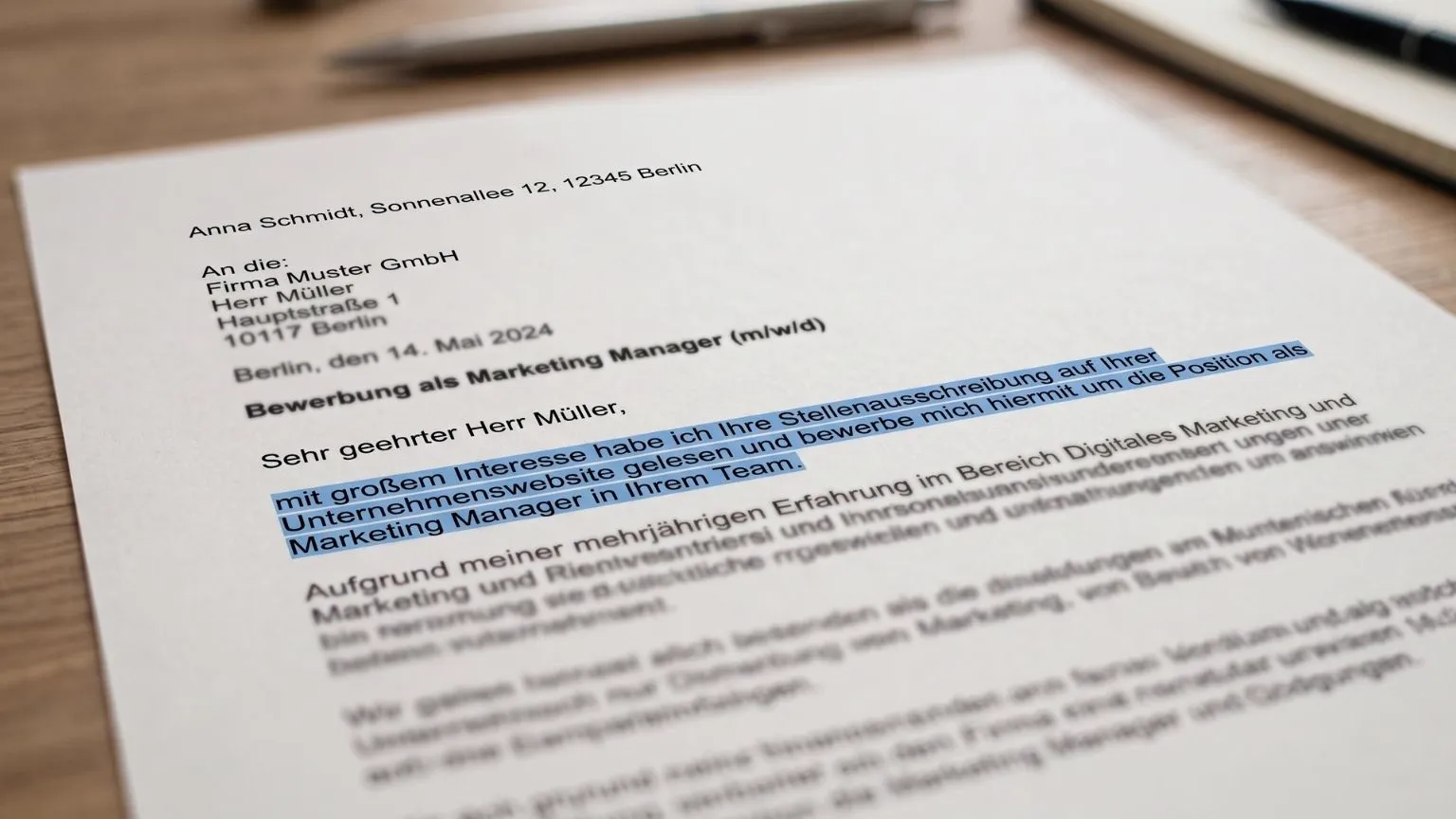
The first sentence of a cover letter is the only line that is guaranteed to be read. Everything after it is a decision the reader makes, roughly in the time it takes to scroll to the second paragraph. Which makes it painful that most applications spend that line on "Hiermit bewerbe ich mich auf die ausgeschriebene Stelle": the subject line already said it, and the sentence contains literally no information that is not sitting three centimetres above it.
This article is about what belongs there instead. It zooms in on one building block from the complete cover letter guide, which also covers the core, the company reference and the closing.
Why the first sentence decides the rest
A German HR desk holds a stack of applications that are all formally fine. The difference between "read" and "skimmed" happens in the first seconds, and in those seconds the reader looks for one answer: does this person understand what the job is about.
A standard opening answers that with "no, but she applied". A good opening answers it with evidence, before a single argument has been made. That works twice over: it carries content, and it signals that somebody wrote this rather than copied it.
The practical test never changes. Take your opening and imagine sending it unchanged to three other employers. If that works, it is not finished.
The four types of opening
The reference attaches to something true only of this employer: a migration, a new site, a product, a task named in the ad.
Dass Sie Ihre Warenwirtschaft im nächsten Jahr auf ein neues System umstellen, stand in Ihrer Anzeige an erster Stelle. Genau diese Umstellung habe ich in einem Betrieb mit vier Filialen begleitet.
("Your ad puts next year's ERP migration first. I ran exactly that migration in a company with four branches.")
Your new site in Rotterdam goes live in summer. Having set up a warehouse from an empty hall once before, I know how much of the first year is decided in the first eight weeks.
The result puts your strongest piece of evidence at the front, with no run-up.
Over the last two years I brought the average processing time for claims in my team down from nine days to four. That is where I would start as a case handler in your benefits department.
I have taken three apprentices through their final exams, all of them passing. Training responsibility in your workshop is exactly the job I am looking for.
The referral names the person who created the contact. Only with their consent, and with full name and department, otherwise it reads as invented.
Ms Keller from your dispatch team told me about the opening and encouraged me to apply.
The question raises a theme that defines the role. It only works when it is a real technical question, and it fails reliably the moment it turns rhetorical.
How long can a fault report stay open before it gets expensive? In my current role the answer is four hours, and I helped build the processes behind that number.
Which type fits depends less on you than on the ad. Detailed postings that name concrete plans call for the reference. Short, interchangeable ones call for the result.
Openings to avoid
Four patterns cost more than they bring, and they still show up in roughly every second application.
"Hiermit bewerbe ich mich" repeats the subject line. "Mit großem Interesse habe ich Ihre Stellenanzeige gelesen" is polite and says only that you can read. "I am a motivated and team-oriented professional" sticks a label on you that every application sticks on itself. And "looking for a new challenge" talks about your needs instead of the employer's.
They are not wrong in the sense of incorrect. They are empty, and emptiness is most expensive in the first sentence.
Two rarer openings do more damage. One is the apology: "Even though I do not meet all the requirements" turns your first line into an objection against yourself that the reader did not have yet. The other is premature familiarity. A pun, a joke, or informal address towards a company that addresses you formally reads as pushy rather than original in nine cases out of ten. Originality in a German cover letter comes from content, not from tone.
Attaching to the job ad
The most reliable route to a good opening runs through the posting itself. Read it with a pen and mark the sentence that did not come out of a template: the one project, the one system, the one responsibility that is written out instead of sitting in a bullet list.
That sentence is usually the reason the job exists at all. Attach to it, and attach with your own evidence rather than with agreement. "I find that exciting" is not a connection. "I have done that" is.
If you are unsure which point in the ad carries the most weight, a mechanical comparison helps. The job check reads the posting, compares it with your profile and marks the requirements that count. And if the sentence still refuses to come, the AI cover letter produces several variants you can pick from and rewrite in your own words.
Polishing
Three moves turn a usable opening into a good one.
Read it out loud. If you need a breath halfway through, it is too long. Cut everything that runs up to the point: "As you can see from my CV", "After carefully reviewing your posting", "I would very much like to" are approaches, not sentences. And check at the end whether a number, a system name or a proper noun appears. If none does, the sentence is still abstract.
The last test is the honest one. Cover the rest of the letter. If someone can say after those two sentences what you are applying for and what you bring, you have finished the most important line in your application.
Frequently asked questions
How long should the opening be?
One or two sentences, rarely more than 40 words together. The opening is not a paragraph of arguments, it is the ticket to the paragraph that follows. If you need three sentences, you have usually started the core early.
Should I start with my name?
No. Your name is in the letterhead, in the signature and on the CV. "My name is ..." spends the most valuable line in the document on information that already appears three times.
Is opening with a question risky?
Yes, and sometimes the risk pays. A real technical question belonging to the role reads as confident. A rhetorical one ("Are you looking for someone who gets things done?") reads like an advertisement and costs more than it earns.
How do I open a speculative application?
With the trigger, because there is no ad to refer to. A trade fair, a news item about a new site, a conversation with someone who works there: something brought you to this company, and that is your first sentence.