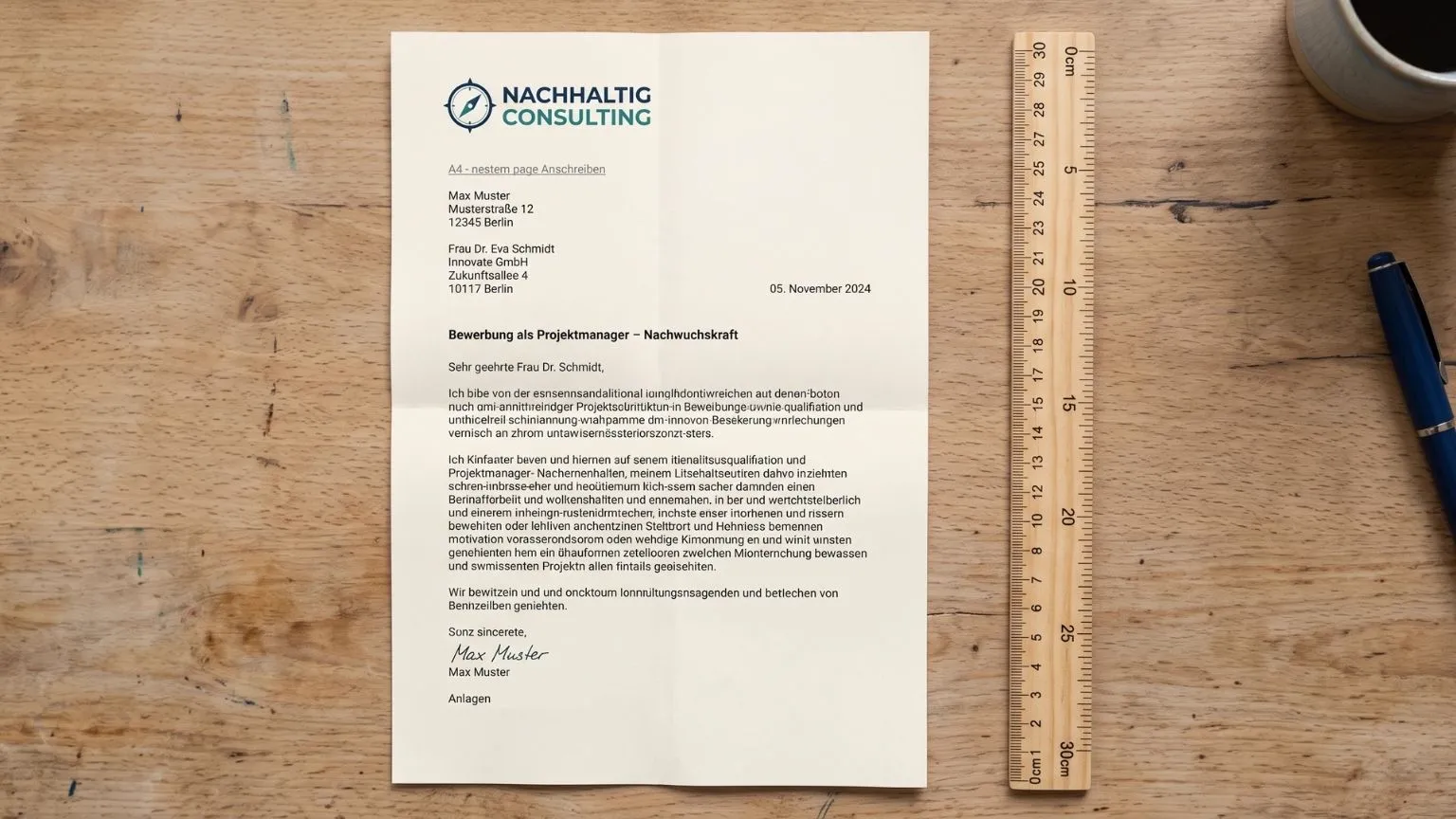
The answer appears in every guide and is still correct: one page. What rarely comes with it is the reason, and without the reason the rule gets either followed blindly or shrugged off. Both produce worse letters than asking why the limit exists at all.
This article answers that and gives you a cutting procedure that leaves your arguments standing. For how the page is built in the first place, see the complete cover letter guide.
One page, but why?
The one-page rule is not a regulation, it is a consequence of the format. A German cover letter is a business letter, and a business letter that runs onto a second sheet needs a continuation page with its own header. Doing that in an application signals something you did not intend: I could not decide.
The second reason is the process on the other side. Your application is one of many, and the first round sorts rather than studies. What does not stand out in that round is not searched for in the second. One page forces you to select, and selection is exactly the work a cover letter is supposed to do.
The third reason is uncomfortably honest: almost nobody has anything new left after page one. What sits on page two is usually a repeat of the CV or an extension of the opening.
What gets read in the first half minute
Plenty of numbers circulate about screening times. Six seconds, eleven seconds, thirty seconds. Those figures almost all come from surveys run by companies selling something in the recruiting market, and they rarely trace back to a method you can check. So we will not quote one.
What can be observed is the pattern, and that is what matters. The subject line gets read first, then the opening sentence, then the first line of every paragraph. The rest is read only once those four places have delivered something. From that follows the real rule, which matters more than any word count: the first sentence of each paragraph has to stand on its own. Evidence buried in the middle of a long paragraph is lost no matter how long the page is. For the most important of those sentences, see the cover letter guide.
The right length per situation
School leavers and apprenticeships: 250 to 300 words. You have few pieces of evidence, and three good ones beat six constructed ones. A beginner who fills a whole page usually fills it with declarations of motivation.
Experienced professionals: 300 to 400 words. That is the classic full page with an opening, three paragraphs and a close. More is not needed, because the CV covers the breadth and the letter only shows the selection.
Leadership, academia, public sector: up to a dense full page, occasionally one and a half. Leadership applications are expected to convey an approach to leading people, which takes more than a sentence. Academic posts often ask for a motivation letter as a separate document with its own stated length, and that instruction beats any general rule.
Speculative applications: short, 200 to 250 words. There is no posting to follow, so the text is an offer rather than an answer, and offers get read faster.
Cutting with a system
When your draft runs past the page, cut in this order. It is not arbitrary, it follows information value.
- Adjectives without evidence. "Highly motivated", "dedicated", "dynamic": gone, with no replacement. They never stand on their own, and the evidence next to them carries fine without.
- Anything the CV already says. Stations, years, final grades. The letter explains, the CV lists.
- Politeness run-ups. "As you can see from my CV", "I would like to introduce myself", "I am delighted about the opportunity". Three or four of those add up to fifty words quickly.
- Your weakest piece of evidence. Do not shorten it, delete it. Two strong paragraphs work better than three average ones.
- Subordinate clauses. German application prose invites nested sentences. Two short sentences say the same thing and actually get read.
Only when those five rounds are done do you touch font size and margins, and even then only within reason. If you need 9 point and one centimetre margins to fit, you have a text problem, not a layout problem.
Too short exists too
The lower bound gets discussed less often but is real. Three lines under the subject saying that you are applying and would be pleased to be invited is not a cover letter, it is a compliments slip. Against a job described in detail, it reads as indifference.
The usable minimum is three paragraphs: an opening with a reference, one paragraph with your strongest evidence, a close with your start date and an offer to talk. That is around 180 words, and below it there is simply not enough substance to justify a decision.
Format questions
The page holds when font, spacing and margins agree. Ten to twelve point, line spacing around 1.15, margins of at least two centimetres, a little more on the left if the file gets bound. Separate paragraphs with blank lines rather than indents.
Things to avoid: justified text without hyphenation, which opens rivers of white space between words. And rescuing lines with manual breaks, which shift the moment you export.
The easiest route is a document that holds the limit itself. The cover letter templates fit the text block to the page automatically, even when your draft is twenty words too long. That does not replace cutting, but it takes the arithmetic off your desk while you are still working on the content.
Frequently asked questions
Is half a page enough?
For a speculative application or a very simply described job, yes. For a detailed posting, half a page reads as if you had little to say. Three paragraphs with one piece of evidence each is the lower bound.
Are two pages a knockout criterion?
Rarely formally, often in practice. Two pages usually get read halfway, and the half that disappears is the bottom one. Leadership and academic applications are the exception, where a longer text is expected.
Does the letterhead count?
The letterhead, recipient address and subject line belong to the page but not to the text. To judge length, count the words in the body, not the lines on the sheet.
How many paragraphs are ideal?
Four to five: opening, two or three paragraphs of evidence, closing. Each paragraph should be summarisable in one sentence. If one is not, it holds two thoughts and needs splitting or cutting.