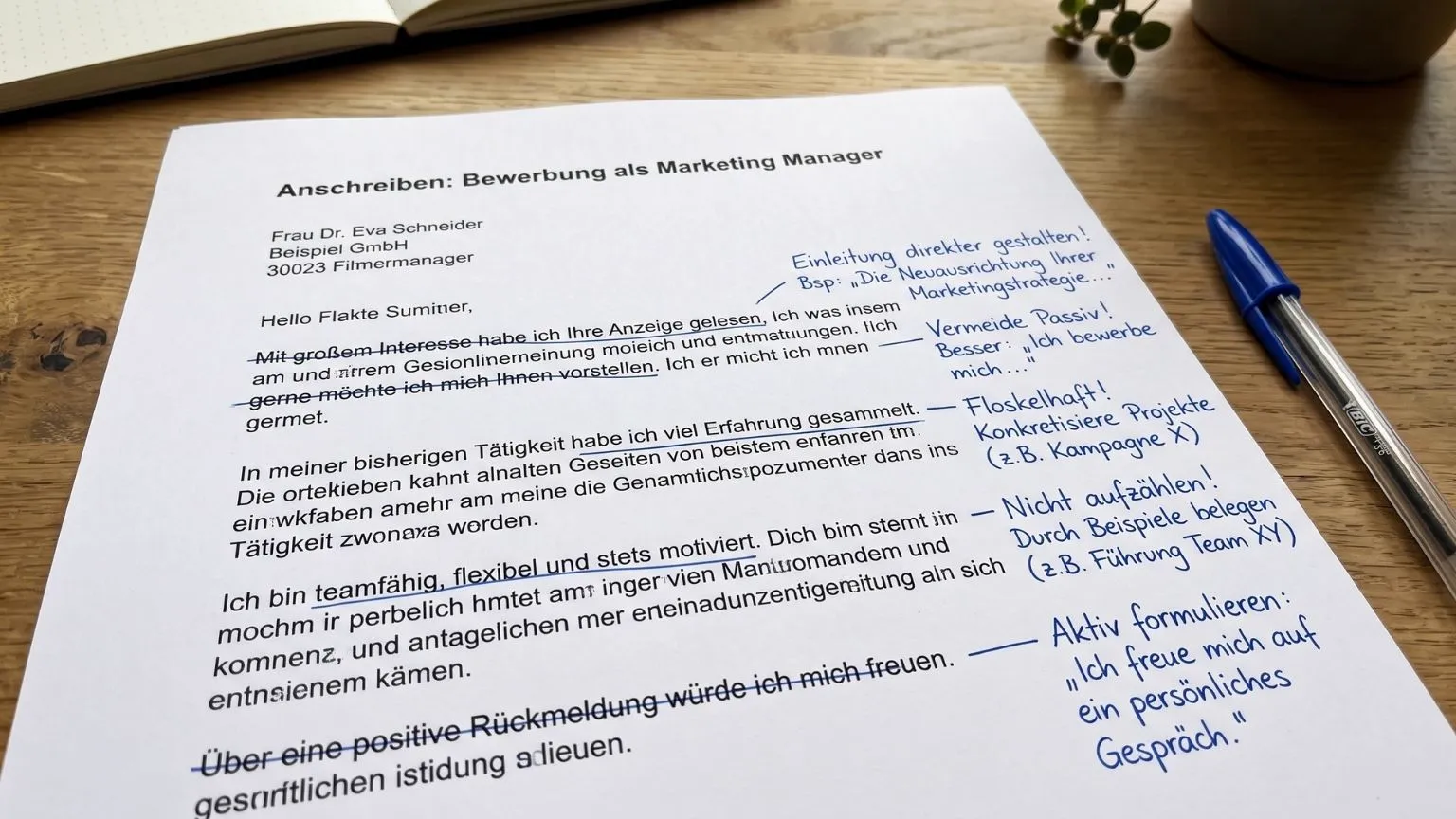
Some sentences appear in German cover letters so often that they have lost their meaning. They are not wrong, they are invisible. Anyone reading applications daily skims past them, and with them past the paragraph they sit in.
This article swaps the most common ones out. Not for other stock phrases, but for sentences that claim something only true of you. For where those sentences belong in the structure, see the complete cover letter guide.
How to spot a canned sentence
Three markers are enough, and you can run them against your own draft.
First: the sentence fits any job. Delete the company name and the job title. Whatever still works afterwards is filler.
Second: the sentence contains no noun from your working day. No system, no procedure, no number, no place. Words like "challenge", "area of responsibility" and "environment" are placeholders for something that never gets named.
Third: the sentence describes an intention rather than a result. "I want to develop further" is an intention. "I took over shift planning" is a result. Anyone can have intentions.
The phrase swap
Fifteen sentences. On the left what everybody writes, on the right the principle, with an example rather than a template, because the right side is yours to fill.
These are given in German, since a German posting expects a German letter. If you are applying in English, the same logic applies word for word.
- "Hiermit bewerbe ich mich auf die ausgeschriebene Stelle." → The subject line said that. Open with the point from the ad that concerns you: "Ihre Ausschreibung nennt die Umstellung auf DATEV als erste Aufgabe."
- "Mit großem Interesse habe ich Ihre Anzeige gelesen." → "Ihre Anzeige habe ich am Freitag gelesen und noch am selben Abend nachgesehen, wie Ihr Standort in Erfurt aufgebaut ist."
- "Ich bin teamfähig." → "Die Schulung für 24 Kolleginnen und Kollegen habe ich zusammen mit der IT gehalten."
- "Ich bin belastbar." → "Sechs Monate lang habe ich zwei Reviere parallel betreut, ohne einen Liefertermin zu verlieren."
- "Ich arbeite selbstständig und strukturiert." → "Die Monatsabschlüsse für drei Gesellschaften laufen seit zwei Jahren ohne Rückfrage durch."
- "Ich bin kommunikationsstark." → "Beschwerden von Kunden bearbeite ich telefonisch bis zum Abschluss, im Schnitt zwölf am Tag."
- "Ich verfüge über gute EDV-Kenntnisse." → "Ich arbeite täglich in SAP MM und baue Auswertungen in Excel mit Pivot und Power Query."
- "Ihr innovatives und dynamisches Unternehmen." → "Dass Sie die Ersatzteilversorgung wieder ins Haus geholt haben, ist genau die Entscheidung, deren Folgen ich kenne."
- "Ich suche eine neue Herausforderung." → "Nach vier Jahren in der Sachbearbeitung möchte ich Verantwortung für ein Team übernehmen."
- "Meine Stärken liegen im Bereich der Organisation." → "Ich plane die Einsätze von neun Monteuren und halte die Termine mit den Kunden."
- "Wie Sie meinem Lebenslauf entnehmen können, habe ich ..." → Delete, no replacement. The reader has the CV.
- "Ich bringe langjährige Erfahrung mit." → "Seit 2019 betreue ich die Lohnabrechnung für rund 180 Beschäftigte."
- "Ich würde mich über eine Einladung freuen." → "Gerne stelle ich Ihnen vor, wie ich die Umstellung angegangen bin."
- "Für Rückfragen stehe ich Ihnen jederzeit zur Verfügung." → Delete. Your number is in the letterhead.
- "Vielen Dank im Voraus für Ihre Mühe." → Delete. An application is not a petition.
The right hand sentences share one property: each contains a number, a system name or a place. That is what tells the reader it did not come out of a template.
Active verbs, real numbers, your own voice
Three moves change the tone of a whole letter.
Verbs instead of nominalisations. "Die Durchführung der Inventur lag in meiner Verantwortung" becomes "Ich habe die Inventur durchgeführt". German application prose pulls hard towards nouns ending in -ung, and each one costs pace. If a sentence holds more than two, rewrite it. English has the same trap with "the implementation of" and "the management of".
Numbers where they are honest. Not every task has a metric, but almost every one has a size: how many sites, how many colleagues, how many cases a day, how many systems. Where you have no number, give the order of magnitude, and invent nothing. A made up percentage costs you the interview in which somebody asks.
Your own voice. A cover letter is allowed to sound like a person who knows what they are talking about. That does not mean casual, it means undisguised. The simplest test: read it out loud. Any sentence in which you do not recognise yourself needs rewriting.
Phrasing by section
Opening:
Ihre Anzeige nennt die Einführung eines neuen Kassensystems. Genau das habe ich im letzten Jahr in fünf Filialen begleitet.
Frau Berger aus Ihrer Disposition hat mir von der Stelle erzählt, nachdem wir auf der Fachmesse über Ihre Tourenplanung gesprochen hatten.
More on that one sentence in the cover letter guide.
Core:
In meiner jetzigen Rolle bearbeite ich täglich rund 40 Vorgänge und übernehme seit einem Jahr die Einarbeitung neuer Kolleginnen.
Als wir die Rückläuferquote senken wollten, habe ich die Prüfschritte in der Annahme neu sortiert. Seitdem geht rund ein Drittel weniger zurück.
Closing:
Ich bin ab dem 1. Februar verfügbar und freue mich auf ein Gespräch.
Gerne zeige ich Ihnen, wie ich die Einarbeitung aufgebaut habe.
For the last paragraph as a whole, see the cover letter guide.
The five minute self-test
Four questions before you send.
- The swap test: replace the company name and job title with another employer's. If the text still works, the reference is missing.
- The noun test: count the words ending in -ung, -heit and -keit in German, or in -tion and -ment in English. More than five on a page and the text reads like an administrative file.
- The evidence test: mark every adjective describing you. If no example sits next to it, delete it.
- The read-aloud test: stumbles are almost always nested sentences.
If passages remain that are correct but pale, a second pair of eyes helps. The AI cover letter reworks single paragraphs without touching your evidence and gives you variants to choose from. What it cannot do, and should not: tell you what you have done. That is in your text, or it is nowhere.
Frequently asked questions
Can I take phrasing from sample letters?
As scaffolding yes, word for word no. Take the shape of a sentence and fill it with your content. A copied sentence has a good chance of appearing in a second application on the same desk.
How do I avoid repetition?
Mark every verb in your draft. If "have", "be" and "can" lead the list, concrete action verbs are missing. Nouns like "responsibility" and "experience" tend to double up as well.
Is "Sehr geehrte Damen und Herren" still acceptable?
Acceptable yes, optimal no. It is the right choice when no name can be found and the wrong one when the name is printed in the ad. Three minutes of searching sit between the two.
Do recruiters notice copy and paste?
With standard sentences yes, because they read the same ones daily. What gives it away further are breaks in register: one paragraph in stiff officialese next to a casual one, or an industry that does not match the job.